
Calculate bottles per layer, layers per pallet and bottles per container using real bottle dimensions, pallet constraints, separator type, container door height and weight limits.
A reliable glass bottle pallet calculation cannot be reduced to length times width times height. A production-ready estimate must compare several packing methods, check whether the loaded pallet can pass through the container door, control gross weight and produce figures that a sales or logistics team can use in a quotation for spirits bottles, wine bottles or custom glass packaging.
This guide explains the logic behind a Glass Bottle Pallet Load Calculator for round, square and rectangular glass bottles.
For SEO and quotation work, this calculator connects bottle dimensions, pallet loading and container capacity in one workflow. It is especially useful when comparing spirits bottles, wine bottles, glass jars and other glass packaging formats before confirming a production loading plan.
If you are still choosing the bottle format, use real maximum diameter and real maximum height rather than nominal volume only. For common spirit formats, the liquor bottle sizes chart can help compare 50 ml, 200 ml, 375 ml, 500 ml, 700 ml, 750 ml and 1 L references before running the pallet load simulation.
What the calculator should measure
The calculation should follow four steps:
- bottles per layer;
- layers per pallet;
- pallets and bottles per container;
- packaging cost and quotation data.
The most important inputs are the real maximum bottle dimensions, not only nominal capacity in milliliters. Two 700 ml bottles may have completely different footprints, shoulder shapes and pallet efficiency.
Container door height matters more than internal height
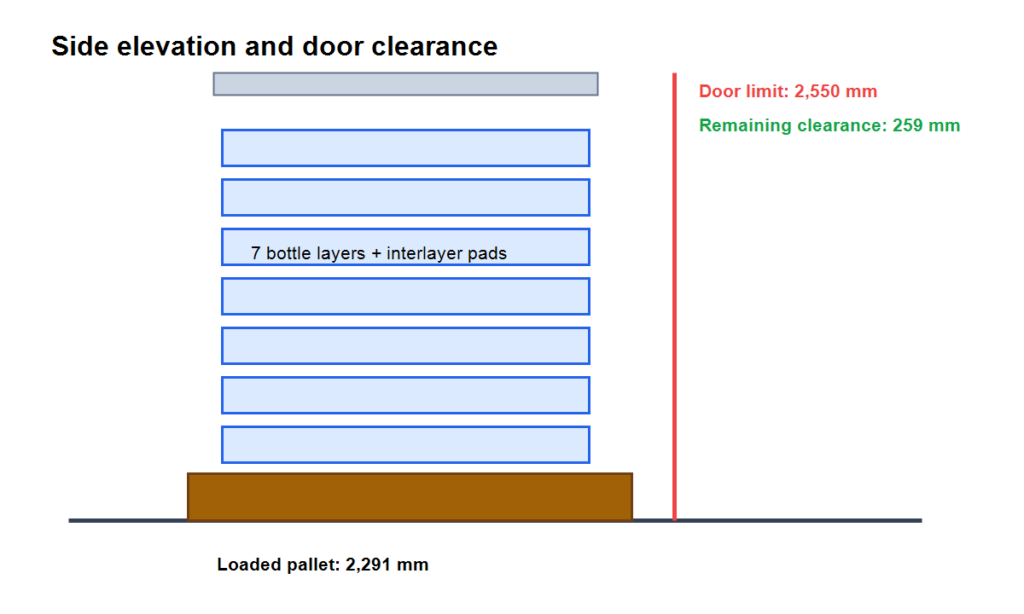
A common mistake is to calculate pallet height against the internal container height only. In practice, the loaded pallet must first pass through the container door.
| Container profile | Conservative recommended loaded pallet height |
|---|---|
| 20 ft GP | 2,250 mm |
| 40 ft High Cube | 2,550 mm |
| Custom container | Manual input required |
Container dimensions vary by carrier and equipment series. Always confirm the actual door opening before loading. The calculator should therefore use the lowest applicable limit: customer maximum pallet height, door opening height minus safety clearance, and any warehouse or handling restriction.
Pallet inputs
The pallet selection should include common presets such as EPAL Euro pallet, industrial pallet, North American pallet and custom pallet. The useful pallet surface is not always the full pallet size.
Effective pallet length equals pallet length plus permitted overhang at both ends, minus safety margins at both ends. The same logic applies to pallet width. By default, overhang should be set to 0 mm and enabled only with a warning.
Bottle inputs
For round bottles, the calculator should ask for maximum body diameter, overall height, bottle weight and minimum horizontal clearance. The effective pitch is the maximum measured diameter including manufacturing tolerance, plus the required clearance.
For square or rectangular bottles, the calculator should use maximum width, maximum depth and maximum height. It should test both orientations, because rotating a rectangular bottle can sometimes add several bottles per layer.
Straight versus staggered bottle packing
For round bottles, two layouts should be compared.
Straight layout
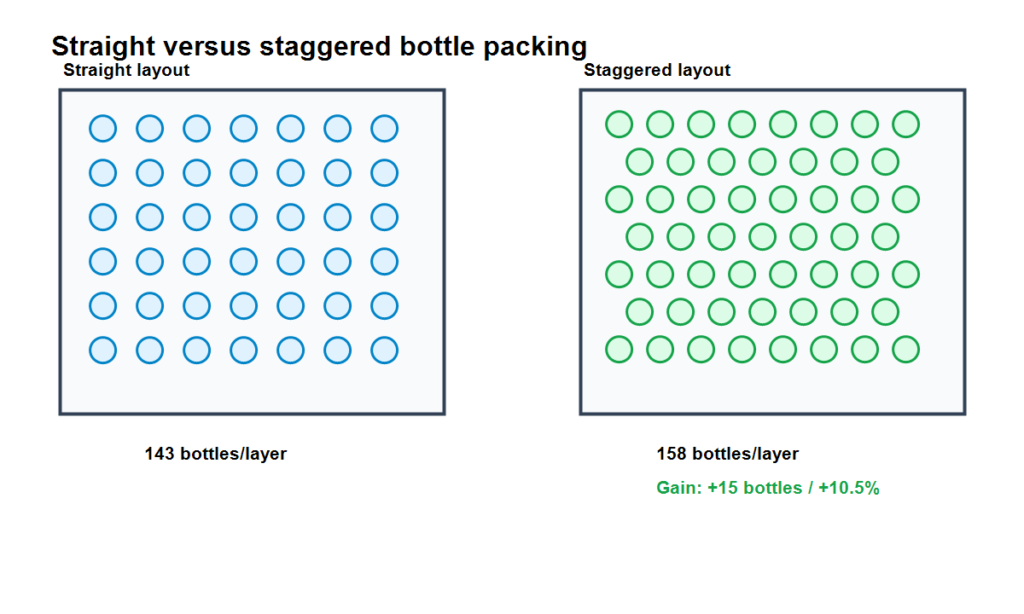
In a straight grid, the number of bottles along the pallet length is calculated as:
floor(effective pallet length / effective pitch)The same formula is used for pallet width. The two results are multiplied to obtain bottles per layer.
Staggered layout
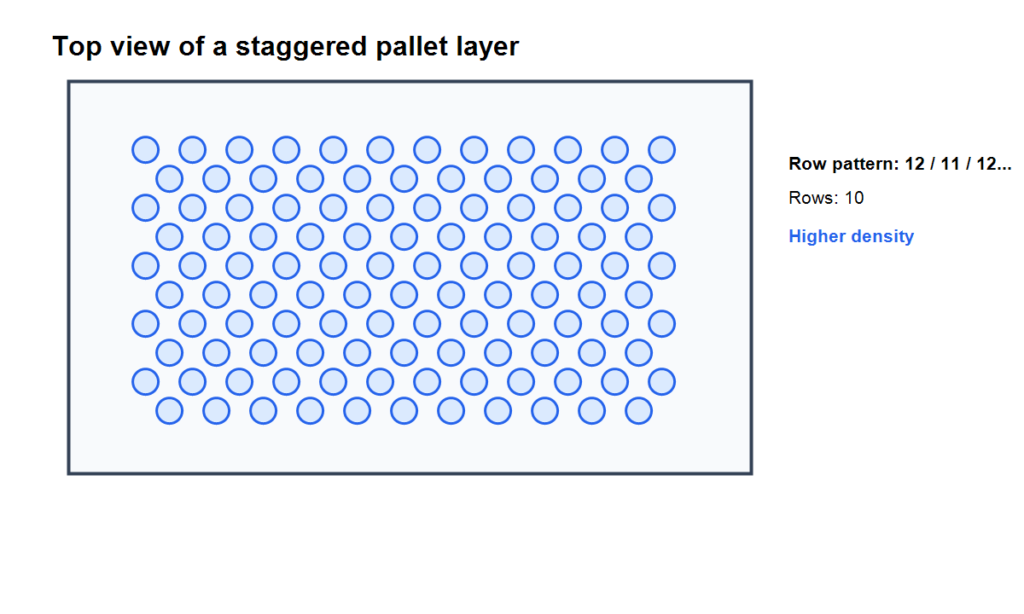
A staggered layout is based on a hexagonal pattern. The vertical spacing between rows is:
row spacing = effective pitch x square root of 3 / 2This layout is often denser than a straight grid for round bottles, although the real gain depends on pallet edges and exact dimensions. The theoretical maximum density of a hexagonal arrangement is about 90.69%, compared with 78.54% for a square grid.
How separators affect bottles per layer
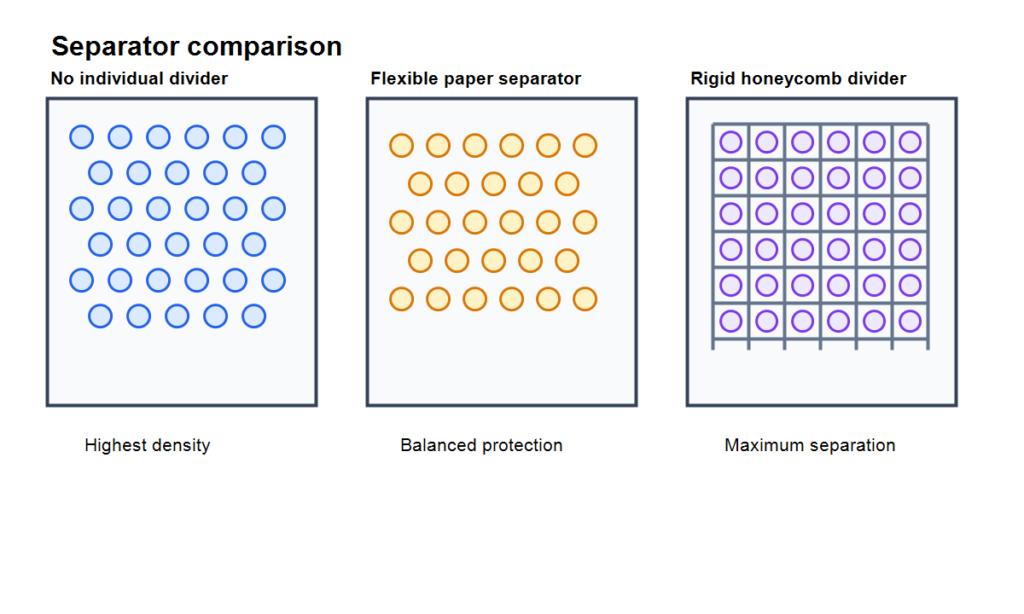
The calculator should compare at least three practical options.
No individual separator
Bottles are separated only by horizontal sheets, wrapping and possible edge protection. This can give the highest density, but it may allow bottle-to-bottle contact.
Flexible paper separator
A flexible paper separator can support a staggered pattern while adding a small allowance for paper, sheet thickness and operational clearance. This is often a balanced option when density and protection both matter.
Rigid honeycomb divider
A rigid honeycomb cardboard divider imposes a straight grid: one cell per bottle. The calculation must separate vertical partition wall thickness from horizontal layer-pad thickness. Combining these into one field produces incorrect results.
Example comparison
Assume a round bottle with an 86 mm maximum diameter, 2 mm clearance, 302 mm height and 520 g weight. On a 1,200 x 1,000 mm pallet with 10 mm edge margins, the usable surface is 1,180 x 980 mm.
| Packing method | Pattern | Bottles per layer |
|---|---|---|
| No divider | Staggered | 158 |
| No divider | Straight | 143 |
| Rigid honeycomb, 91 mm pitch | Straight | 120 |
With a conservative 20 ft container limit of 2,250 mm, six layers may fit while seven layers may be too high. With a 40 ft High Cube limit of 2,550 mm, seven layers may fit while eight layers may exceed the safe operational limit.
| Packing method | 20 ft, 6 layers | 40 ft HQ, 7 layers |
|---|---|---|
| Staggered | 948 bottles per pallet | 1,106 bottles per pallet |
| Straight grid | 858 bottles per pallet | 1,001 bottles per pallet |
| Rigid honeycomb | 720 bottles per pallet | 840 bottles per pallet |
How to calculate layers per pallet
The vertical calculation should include pallet height, bottom pad, bottle height, interlayer pads, top protection and any top frame.
Total height = pallet height + bottom pad + N x bottle height + (N - 1) x interlayer pad + top protection + top frameThe remaining clearance should be shown clearly. A low-clearance warning should appear when the margin below the container door is less than 30 mm.
Weight checks
The gross pallet weight should include bottle weight, pallet tare, separators, layer pads, top protection, film and corner protection. The result should be compared with pallet safe working load, forklift limits, container payload and road transport limitations.
Pallets per container
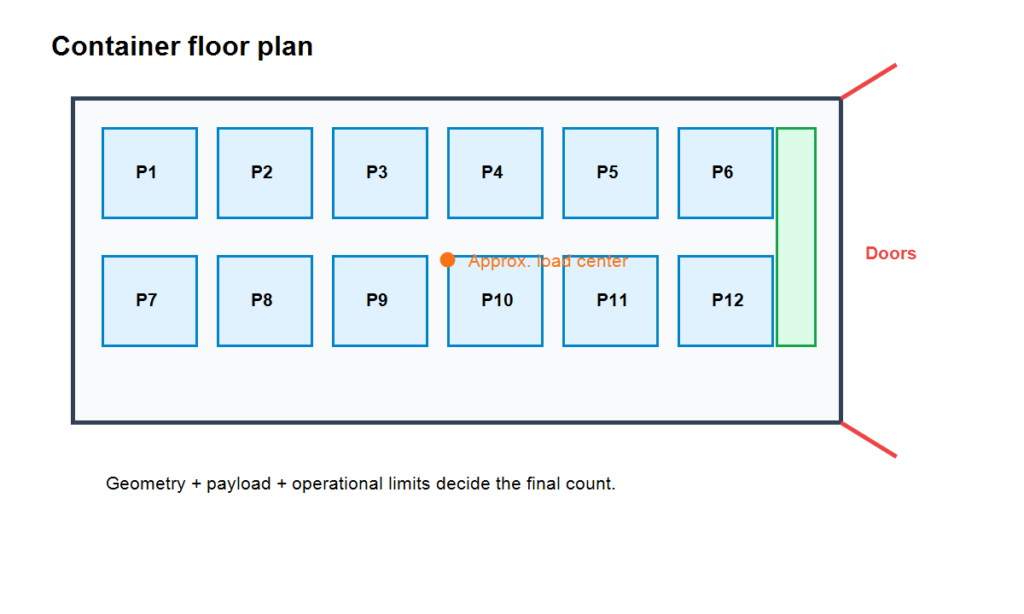
For container loading, a simple floor-area division is not enough. A real calculator should test pallet orientation, mixed rows, door clearance, residual space and payload. The final number of pallets per container should be the minimum of geometric fit, payload limit and the operational maximum defined by GlassRock or the customer.
Recommended result levels
The calculator should not present one number as an absolute truth. It should distinguish between:
- Theoretical maximum: geometry with minimal margins;
- Recommended operational load: door clearance, tolerances, packaging allowances and weight limits included;
- GlassRock validated load: factory-confirmed loading for a specific bottle reference.
When a GlassRock validated configuration exists, it should take priority over the purely geometric result.
Recommended outputs
A useful pallet load report should include bottles per row, rows per layer, bottles per layer, number of layers, bottles per pallet, loaded pallet height, gross pallet weight, pallets per container, bottles per container and cargo weight.
The best version should also generate dynamic SVG drawings: top view of the pallet layer, straight versus staggered comparison, divider comparison, side elevation and container floor plan. SVG is ideal because each calculation has its own layout and remains sharp in PDFs.
Technical warnings to display
- The calculated pallet is higher than the selected container door opening.
- Clearance below 30 mm may not be operationally sufficient.
- The gross pallet weight exceeds the pallet safe working load.
- The geometric number of pallets exceeds the container payload limit.
- This layout permits bottle-to-bottle contact and must be validated for the selected bottle finish and transport method.
- The packing pattern is calculated geometrically and has not yet been factory validated.
- For curved or asymmetric bottles, the rectangular footprint is a conservative approximation.
FAQ
How many glass bottles fit on a pallet?
It depends on bottle diameter or footprint, pallet size, clearance, separator type, number of layers and weight limits. A round bottle in a staggered pattern may fit more units than the same bottle in a straight grid.
Is staggered bottle packing more efficient?
For round bottles, yes, it is often more efficient. The real gain depends on the exact pallet dimensions and the edge losses at the perimeter.
How does a honeycomb divider affect capacity?
A rigid honeycomb divider improves individual separation but normally reduces capacity because it imposes a straight grid and adds partition thickness.
Should pallet height be based on internal height or door height?
Door height should be the main operational limit. A pallet may fit inside a container but still fail to pass through the door.
Can square bottles be rotated to increase capacity?
Yes. Rectangular bottles should be tested in both orientations, and advanced calculators can also test mixed orientations in remaining strips.
Can this calculation be used as a final loading specification?
No. It is an estimate based on entered dimensions. Final packing must be confirmed through production trials, actual pallet measurements, actual container dimensions and transport validation.
Related GlassRock resources
Use these internal resources when a pallet calculation needs to become a real sourcing or quotation discussion:
- Spirits bottles manufacturer for liquor, gin, vodka, rum and premium spirits packaging projects.
- Wine bottles manufacturer for Bordeaux, Burgundy, sparkling and custom wine bottle formats.
- Glass jar manufacturer when the packing study concerns jars rather than narrow-neck bottles.
- Closures and labels for projects where caps, corks, capsules, labels or decoration affect the final packed height and shipping configuration.
- Glass packaging FAQ und GlassRock resources for broader packaging, sourcing and logistics questions.
Sources and practical references
Disclaimer: This calculation is an estimate based on the entered dimensions. Final packing must be confirmed through production trials, actual pallet measurements, actual container dimensions and transport validation.
Loading pattern illustrations
The following simplified drawings show the main loading patterns and operational checks used by the calculator.
Top view of a staggered pallet layer
Top view of a staggered pallet layer Effective pallet surface Edge margin Row pattern 8 / 7 / 8 / 7… Rows: 9 Staggered layout Higher density Illustration 1: top view of a staggered round-bottle layer inside the usable pallet area.
Straight versus staggered bottle packing
Straight versus staggered bottle packing Straight layout Staggered layout 143 bottles/layer 158 bottles/layer +10.5% Illustration 2: staggered packing can increase round-bottle density compared with a straight grid.
Separator comparison
Divider comparison No individual dividerFlexible paperRigid honeycomb Highest density, more contact risk Staggered with paper allowance Straight cells reduce capacity Illustration 3: rigid honeycomb dividers impose straight cells, while flexible separators can follow a staggered pattern.
Side elevation and door clearance
Side elevation and door clearance Door limit: 2,550 mm Remaining clearance: 259 mm Pallet 7 bottle layers + interlayer pads Loaded pallet height: 2,291 mm Illustration 4: the vertical calculation compares loaded pallet height against the container door limit.
Container floor plan
Container floor plan Doors P1P2P3P4P5P6P7P8P9P10 Mixed pallet orientations can improve floor use. Final count must also respect payload and handling limits. approx. load center Illustration 5: a container floor plan should
Top view of a staggered pallet layer
place each pallet geometrically, then apply payload and operational limits.
Straight versus staggered bottle packing
Separator comparison
Side elevation and door clearance
Container floor plan
 English
 French
 Spanish
 Portuguese
 German
 Italian
 Japanese
 Korean
 Arabic
 Russian