
Every gram of glass in your bottle multiplies across the supply chain. Lightweight glass bottles are no longer a niche sustainability story — they are a practical lever for procurement managers facing rising freight rates, retailers chasing scope 3 emissions targets, and brands that want a thinner, more elegant feel in the hand. This guide breaks down what “lightweight” really means in glass packaging, where the weight comes from, and how to specify it without sacrificing strength or shelf appeal.
What “Lightweight” Actually Means in Glass Packaging
Lightweighting is the deliberate reduction of glass mass in a container while preserving structural integrity, decoration surface, and consumer experience. For wine, a standard 750ml Bordeaux bottle weighs anywhere from 380 g to 600 g depending on glass distribution. A lightweight version typically targets the 380–420 g range. For spirits and beverages, the spread is even wider — premium decanters can exceed 900 g, while modern spirits packaging often lands between 450 g and 550 g.
The benchmark that matters is grams of glass per milliliter of capacity. Below 0.55 g/ml, you are firmly in lightweight territory. Above 0.75 g/ml, you are paying for heft that no longer correlates with quality perception once the bottle is on the shelf.
Where the Weight Comes From: Design Drivers
Three structural choices dominate the weight equation. First, glass thickness at the body and base — many legacy molds carry 3.5 to 4.5 mm of glass where 2.8 to 3.2 mm would be structurally sufficient with modern furnace and forming technology. Second, the punt (the indentation at the base) — a deep punt looks premium but adds 30 to 60 g of glass and complicates lightweighting. Third, the shoulder geometry — sharp shoulders concentrate stress and force engineers to add glass back to compensate.
Square-section bottles are an underrated lever. By replacing a fully cylindrical body with a square cross-section, designers can distribute glass more uniformly along the long sides while keeping the visual signature flat and shelf-ready. The slim-neck variant of the Square Light Green Olive Oil Bottle Slim Round Neck 1000ml shown below illustrates the principle on a familiar 1000ml format.
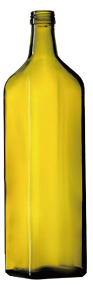
Featured Product: Square Light Green Olive Oil Bottle Slim Round Neck 1000ml
Techniques for Glass Bottle Weight Reduction
Modern glass bottle weight reduction rests on three industrial techniques that compound when used together.
NNPB Forming (Narrow Neck Press and Blow)
NNPB pushes glass into the mold under controlled pressure rather than relying on gravity to distribute it. The result is a more uniform wall thickness, which lets engineers shave 15 to 25 percent of mass off comparable blow-and-blow designs without losing impact strength. NNPB is now standard for high-volume beverage bottles and is increasingly used for wine and spirits.
Optimized Glass Distribution
Even on traditional blow-and-blow lines, finite-element analysis lets engineers map where glass actually carries load versus where it sits idle. Moving mass from the shoulder and base center toward the heel and contact ring produces stronger, lighter bottles. Expect 5 to 12 percent weight savings from this optimization alone.
Surface Treatments
Hot-end and cold-end coatings increase scratch and impact resistance, which gives engineers headroom to reduce wall thickness while keeping bottle-to-bottle abrasion damage in check on the filling line. Without coatings, lightweighting tends to drive up breakage rates — with them, you stay neutral or improve.
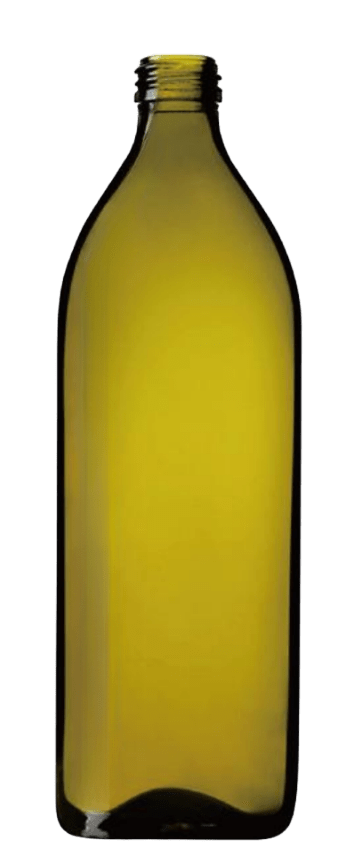
Featured Product: Wide Round Light Green Olive Oil Bottle 1000ml
Wide-round formats like the Wide Round Light Green Olive Oil Bottle 1000ml above respond particularly well to NNPB forming because the rounder profile makes pressure distribution more predictable than tall, narrow shapes.
Lightweight Wine Bottles and the Industry Shift
Lightweight wine bottles have moved from outlier to default in the entry and mid-price segments. Major retailers in the UK, Nordic countries, and Canada have published explicit weight ceilings — typically around 420 g for still wine — and producers who exceed them risk losing listings. Even in the premium tier, where a heavier bottle once signaled quality, consumer research now shows that buyers under 40 increasingly associate excessive weight with environmental indifference, not luxury.
For wine, the practical lightweight playbook is: a 400 g body with a shallow punt of 18 to 22 mm, NNPB-formed, paired with a closure that fits the lighter neck. Bordeaux and Burgundy silhouettes can both be lightweighted without altering the shelf signature your brand already owns.
Cost, Sustainability, and the Tradeoffs
The economics of weight reduction are usually decisive. A 100 g reduction on a 750 ml bottle, multiplied across a 40-foot container, saves roughly 1.4 tons of payload — enough to reduce glass bottle shipping cost meaningfully on transoceanic routes. On a per-bottle basis, lightweighting typically cuts freight by 8 to 15 percent and lowers the embodied CO₂ of the package by 10 to 20 percent.
The tradeoffs are real but manageable. Thinner glass demands tighter quality control at the forming stage and more careful handling on filling lines. Decoration techniques such as deep embossing or heavy frosting may need to be redesigned for the new wall profile. And consumers in some luxury categories still expect heft — there, the answer is often a slightly heavier base ring with a lighter body, preserving the in-hand feel without paying the full weight penalty.
For brands pursuing eco-friendly glass packaging as a positioning move, the carbon math also works upstream. Less glass means less raw material melted, lower furnace energy per bottle, and easier alignment with cullet (recycled glass) targets, since lighter bottles allow higher cullet ratios without compromising performance.

Featured Product: Square Light Green Olive Oil Bottle Slim Round Neck 500ml
Smaller formats such as the Square Light Green Olive Oil Bottle Slim Round Neck 500ml show how the same lightweighting principles travel cleanly across sizes once the base geometry is right.
How to Specify Lightweight Glass Bottles with Your Supplier
If you are briefing a manufacturer on a weight-optimized project, lead with the target g/ml ratio rather than an aesthetic reference. Share your filling line specs, expected internal pressure (especially for sparkling and carbonated drinks), and any decoration constraints. Ask for an FEA simulation before tooling is cut — a quick model run will catch stress concentrations that would otherwise force a weight add-back during pilot production. Finally, plan a small-batch validation run before locking in the mold, since lightweight designs amplify the impact of even minor mold tolerances.
The case for lightweight glass bottles is no longer about idealism. It is shipping cost, retailer compliance, and brand positioning in a market that increasingly reads excess weight as waste. Get the design brief right at the start, work with a manufacturer who can model the structural tradeoffs, and the weight you remove will pay for itself many times over.
 English
 French
 Spanish
 Portuguese
 German
 Italian
 Japanese
 Korean
 Arabic
 Russian