
Glass Jar Sizes: Capacities, Finishes and How to Choose One
Standard glass jar sizes run from 30 mL sample pots to 1 litre storage jars, with 120 mL, 250 mL, 500 mL and 720 mL as the everyday workhorses for food, cosmetics and candles. But capacity is only the first line of a jar specification: neck finish, brimful volume, label panel and base diameter decide whether a jar actually works on your filling line and in your carton. This guide covers all of it.
Glass jar size chart
| Capacity | US fl oz | US cups | Typical products |
|---|---|---|---|
| 30 mL | 1.01 | 0.13 | Cosmetic samples, balms, caviar |
| 60 mL | 2.03 | 0.25 | Creams, spice samples, favors |
| 120 mL | 4.06 | 0.51 | Jams, cosmetics, votive candles |
| 212 mL | 7.17 | 0.90 | European jam standard |
| 250 mL | 8.45 | 1.06 | Jams, honey, yogurt, candles |
| 370 mL | 12.51 | 1.56 | Preserves, sauces, pickles |
| 500 mL | 16.91 | 2.11 | Pickles, sauces, dry goods |
| 720 mL | 24.35 | 3.04 | Passata, large preserves |
| 1 L | 33.81 | 4.23 | Bulk storage, fermentation |
Capacities are nominal fill volumes; brimful capacity is higher. Conversions use 29.5735295625 mL per US fl oz and 236.5882365 mL per cup. For the US canning range in ounces, see our mason jar sizes guide.
What a jar specification actually contains
Two jars of the same nominal capacity can be incompatible with your line. A complete specification states: nominal fill capacity and brimful capacity (the difference is your headspace), overall height and maximum body diameter with tolerances, neck finish designation, label panel height and circumference, glass weight, and case and pallet quantities. Those last figures are what turn a jar into a freight cost — the calculation is worked through in our packaging dimensions guide.
Neck finishes and lid compatibility
The finish is the threaded or lugged top of the jar, and it — not the capacity — determines which lid fits. Common European food finishes are twist-off lug caps in 43, 53, 63, 70 and 82 mm; North American mason-style jars use 70 mm regular and 86 mm wide mouth; cosmetic jars typically use continuous-thread finishes designated in GPI/SPI format (for example 58-400). Two rules save projects: choose the finish before the mold, and confirm that your lid supplier and jar supplier quote the same designation — an 82 mm lug and an 82 mm continuous thread are not the same part.
Choosing a jar size by product
| Product | Typical sizes | What drives the choice |
|---|---|---|
| Jams and preserves | 120, 212, 250, 370 mL | Retail price point; 250 mL is the European default |
| Honey | 250, 500 mL | Sold by weight — density means 500 mL ≈ 700 g |
| Cosmetic creams | 30, 50, 120 mL | Product cost per mL; wide opening for thick textures |
| Candles | 120, 250, 500 mL | Burn geometry — straight sides, flame-to-glass distance |
| Pickles and vegetables | 370, 500, 720 mL | Piece size dictates opening diameter |
| Sauces and passata | 250, 500, 720 mL | Fill temperature and vacuum sealing |
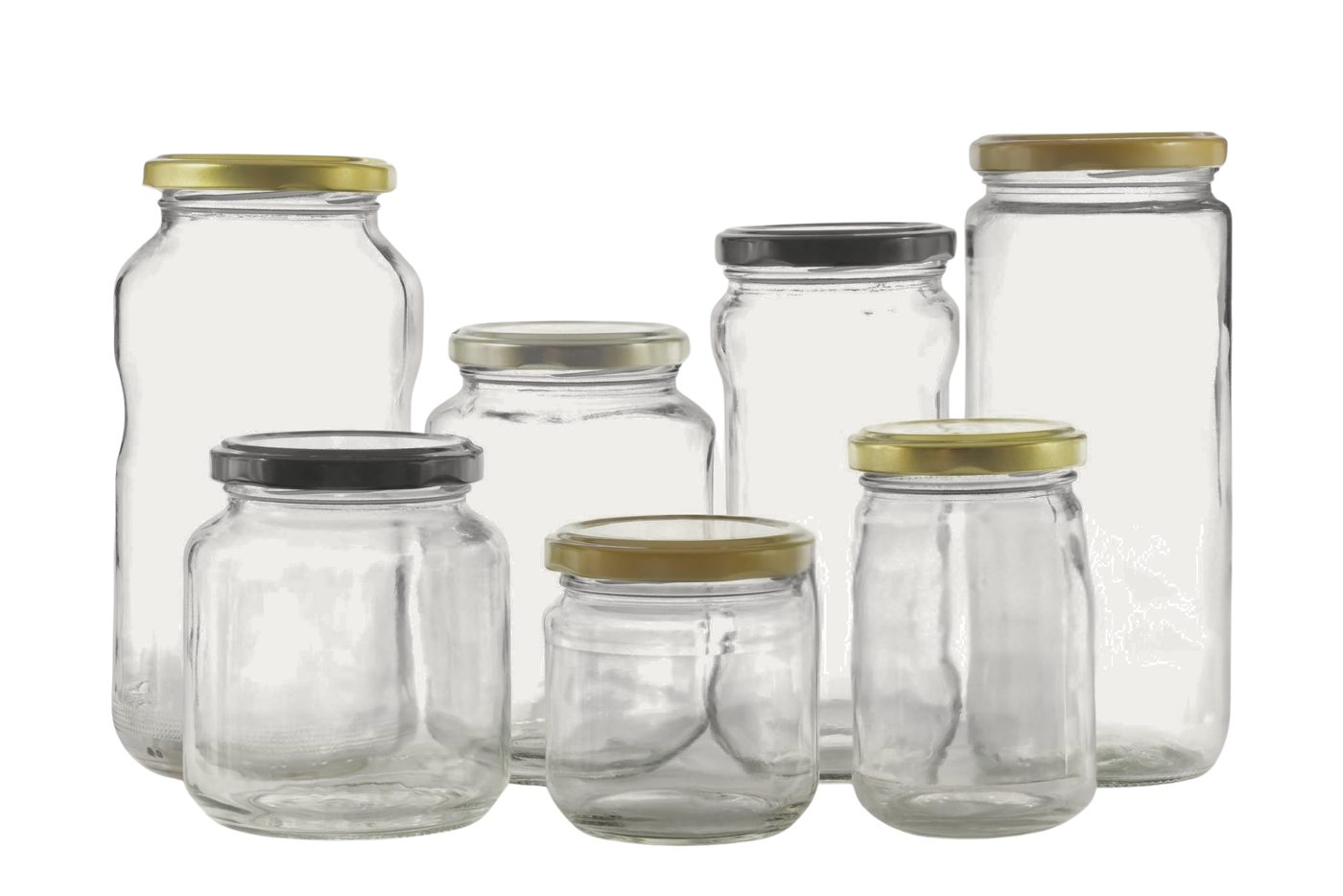
One capacity fits many shapes: a 250 mL jar can be tall and narrow, squat and wide, hexagonal or quilted — each with different label areas and case counts. Work from the technical drawing, never from the capacity alone.
FAQ
What are standard glass jar sizes?
In metric markets: 30, 60, 120, 212, 250, 370, 500, 720 mL and 1 L. In North America jars are sized in ounces — 4, 8, 16, 32 and 64 oz.
How many ounces is a 250 mL jar?
8.45 US fluid ounces, or 1.06 US cups. It is the closest metric equivalent to the American 8 oz jar (236.59 mL).
What is the difference between nominal and brimful capacity?
Nominal capacity is the intended fill volume; brimful is the volume to the very top of the jar. The difference is the headspace needed for sealing and thermal expansion — typically 5–10%.
How do I know which lid fits my jar?
By the neck finish designation, not the capacity. Two 250 mL jars can take 63 mm and 70 mm lids. Always match the finish code quoted by both the jar and lid supplier.
What size jar for candles?
120 mL for votives and travel sizes, 250 mL for standard container candles, 500 mL for three-wick. Straight-sided jars distribute heat more predictably than shouldered ones.
Are glass jars measured in mL or grams?
Jars are specified by volume (mL); the product inside is usually declared by net weight (g). Because density varies, a 500 mL honey jar holds about 700 g — the volume-versus-weight distinction we detail in our 4 oz and 8 oz guide.

 English
 French
 Spanish
 Portuguese
 German
 Italian
 Japanese
 Korean
 Arabic
 Russian