
A bottle technical drawing is the dimensioned 2D document that defines a glass container — profile, height, diameter, capacity, glass weight, neck finish and base — each with a tolerance. Once you sign it, it is the reference the mold maker cuts steel from and the standard your shipments are inspected against. This guide walks through each zone of the sheet and what a buyer should check before approving it.
Technical drawing vs. glass bottle specification sheet
Buyers usually meet two documents, and they are not interchangeable:
- A glass bottle specification sheet (or datasheet) is a one-page summary: capacity, weight, height, diameter, finish size and pallet quantities. You use it to shortlist a stock bottle.
- A technical drawing is the full engineering definition: every diameter, radius and height, with tolerances, plus separate detail views of the finish and base. You approve it for a private mold, and your filler and closure supplier need it to confirm compatibility.
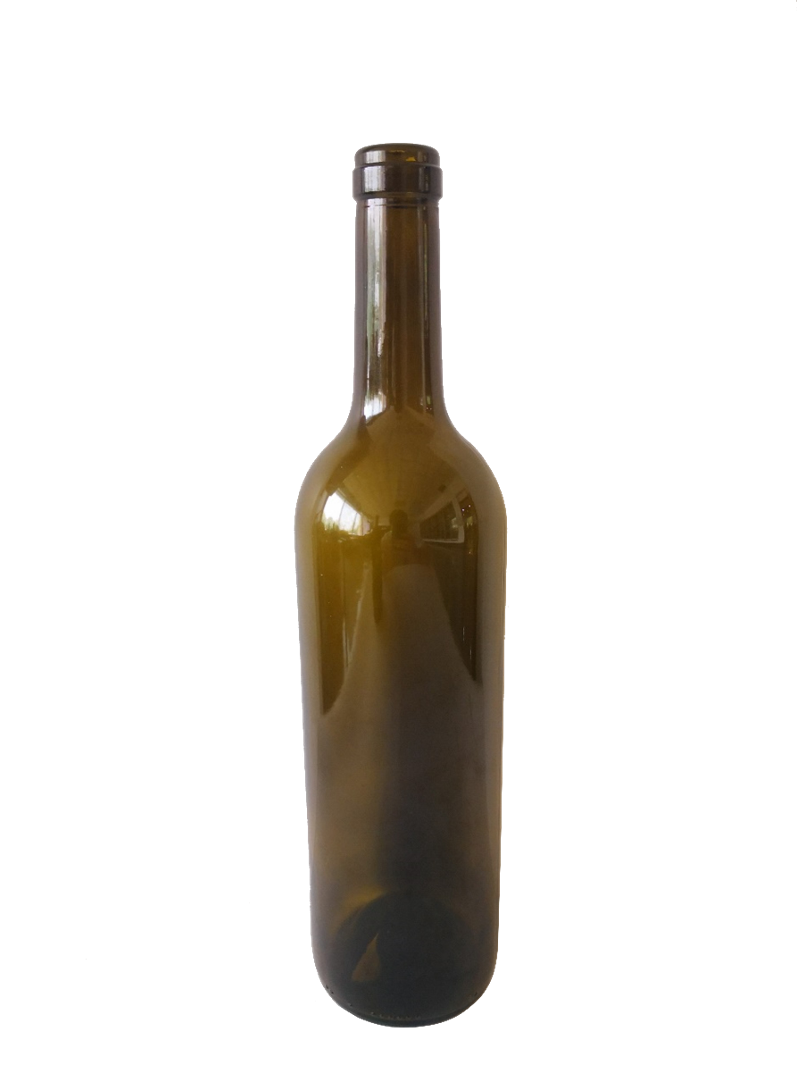
For example, the datasheet for our 750ml アンティークグリーン ストレートボルドーボトル ロングネック #530 lists 750ml capacity, 530g weight, 310mm height and 76mm diameter. Those numbers tell you whether the bottle suits your range; the drawing tells you whether it will run on your line.
Reading a bottle technical drawing, zone by zone
Most drawings follow the same layout: a title block, a main elevation of the bottle (often half in section to show wall and base thickness), a base view, and enlarged details. Dimensions are in millimeters unless the title block says otherwise.
| Zone | What it shows | What to check |
|---|---|---|
| Title block | Item or mold number, revision, date, units, scale, glass color, nominal capacity, weight | That you are reading the latest revision — and that everyone else is too |
| Main elevation | Overall height, body diameter, shoulder and heel radii, contact points | Height under your filler and capper; diameter against cartons, dividers and star wheels |
| Finish detail | Enlarged view of the neck finish with its own dimensions and standard reference | Match with the closure supplier’s drawing |
| Capacity notes | Brimful capacity, nominal capacity, fill point height | Headspace for your product, fill temperature and closure |
| Base view | Punt (push-up) height, bearing surface, knurling, engraving and mold markings | Stability, any registration lug your labeler needs, embossed text |
Also read the general notes: verticality (how far the finish may lean off the base centerline) and ovality (departure from a true circle) both affect capping and labeling at speed.
The neck finish drawing: the most critical detail
The finish is the only part of the bottle that has to mate with another component, so it gets its own enlarged view and the tightest tolerances on the sheet. A neck finish drawing normally references an industry standard (GPI/SPI finishes in North America, CETIE data sheets in Europe) so that closures from any compliant supplier fit. For threaded finishes, the standard dimensions are identified by letters:
| Letter | Dimension | Why it matters |
|---|---|---|
| T | Outside diameter of the thread | Sets the nominal closure size (the “28” in a 28-400 finish) |
| E | Outside diameter of the neck at the thread root | With T, defines thread depth and cap engagement |
| I | Minimum inside diameter of the opening (bore) | Must clear filling tubes, pourers, plugs and dip tubes |
| S | Top of finish to the start of the thread | Controls how the cap starts and where it seats |
| H | Top of finish to the bead or shoulder | The cap skirt must clear it to seal on the top surface |
Non-threaded finishes are dimensioned differently. A crown finish is defined by the outer diameter and profile of the locking ring — our 330mlロングネック青ビール瓶 lists a 26.5mm crown diameter on its datasheet. A cork finish is defined mainly by its bore: the internal diameter at the mouth and at a stated depth, because the bore profile is what holds the cork. See also our neck finish compatibility guide.

Capacity, weight and tolerances
Brimful vs. nominal capacity
A drawing states two volumes. Brimful (overflow) capacity is the bottle filled to the very top. Nominal capacity is the declared content, reached at the fill point — a height given as a distance down from the top of the finish. The difference is headspace, which absorbs thermal expansion and leaves room for the closure. If you hot-fill, carbonate, or use a long cork, tell your supplier before the drawing is finalized.
Glass weight
Weight is specified in grams with a tolerance. It drives freight cost, perceived quality and strength.
Why every number carries a ±
Glass is formed hot in metal molds, shrinks as it cools, and the molds wear across a run. Every dimension is therefore a nominal value plus an allowed variation. Design your line settings, cartons and labels for the extremes of the tolerance band, not the nominal. The same values become the pass/fail limits during pre-shipment inspection.
Base, punt and label panel
The base view shows the punt or push-up height, the bearing surface the bottle stands on, and any knurling (the fine stippled ring that reduces scuffing and thermal shock on the contact surface). It also shows what is engraved in the glass: capacity marks, mold and cavity numbers for traceability, and any embossed brand text. If your labeler orients bottles mechanically, check that the registration feature is drawn.
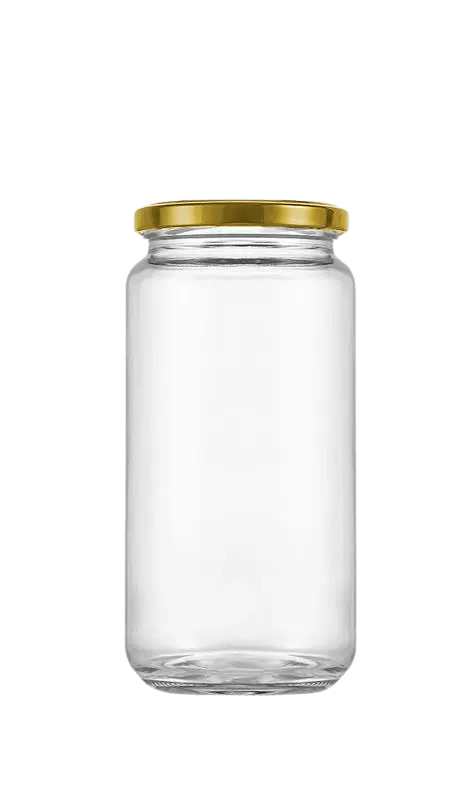
The label panel is the straight (or slightly recessed) zone of the body. The drawing gives its height and position; your label must sit inside it with a margin, because labels applied over shoulder or heel curves wrinkle. Wide-mouth containers follow the same logic — the 1000ml 丸型ショートネックガラス瓶, for instance, pairs a 91mm body with an 82mm cap size, so the finish detail dominates the drawing.
Checklist before you approve a drawing
- Confirm the revision letter and date with every party.
- Send the finish detail to your closure supplier for written confirmation of fit.
- Send the full drawing to your filler or co-packer for height, diameter, contact points and fill point.
- Check both capacities against your declared volume and product behavior.
- Overlay your label artwork on the label panel dimensions.
- Read the engraving notes — embossed text is cut into the mold and is costly to change.
- Sign and file it as the reference for samples and production.
Changes are cheap on paper and expensive in steel, so settle them before any mold tooling is ordered.
よくあるご質問
What is a bottle technical drawing?
A bottle technical drawing is the dimensioned 2D document that defines a glass container: its profile, height, diameter, capacity, glass weight, neck finish and base, each with a tolerance. Once approved, it is the reference for mold making and for quality control.
Is a glass bottle specification sheet the same as a technical drawing?
No. A glass bottle specification sheet summarizes the headline values, such as capacity, weight, height, diameter and pallet quantity. The technical drawing contains the full geometry and tolerances behind those values and is the document that governs production.
What is the difference between brimful capacity and nominal capacity?
Brimful capacity is the volume of the bottle filled to the very top of the finish. Nominal capacity is the declared volume, measured at the fill point marked on the drawing. The gap between the two is the headspace left for expansion and the closure.
What do T, E, I, S and H mean on a neck finish drawing?
They are the standard finish dimensions: T is the outside diameter of the thread, E the outside diameter of the neck at the thread root, I the minimum inside diameter of the opening, S the distance from the top of the finish to the start of the thread, and H the height from the top of the finish to the bead or shoulder.
Why does every dimension on a glass bottle drawing have a tolerance?
Glass is formed hot in metal molds and shrinks as it cools, and the molds wear over a production run, so no two bottles are perfectly identical. Tolerances define the acceptable variation that your filling line, closure and label must be able to handle.
 English
 Français
 Español
 Português
 Deutsch
 Italiano
 日本語
 한국어
 العربية
 Русский