
For brands bottling raw, creamed, or infused honey, glass honey jars remain the default packaging choice: they are inert, fully recyclable, and let the color and clarity of the honey sell the product before a label ever gets read.
Why Glass Is the Right Packaging for Honey
Honey is acidic and viscous, and over time it can interact with plastic resins in ways that affect flavor and shelf appearance — glass has none of that risk. Glass honey jars are non-porous and chemically neutral, so they don’t absorb aroma or leach compounds into the product, even during the slow crystallization that raw honey naturally goes through in storage.
Glass is also the format most honey buyers expect at a market stall or on a specialty-foods shelf: it signals an artisanal, unprocessed product in a way that plastic squeeze bottles don’t. For export-focused brands, glass jars are widely accepted under food-contact regulations in the US and EU, which simplifies compliance paperwork compared to some plastic resins.
Glass Honey Jar Shapes and Sizes
Most honey brands work from a small set of proven jar shapes rather than commissioning a custom mold from scratch, which keeps lead times and tooling costs down. The table below lists the capacity range we see most often for glass honey jars sold at retail and foodservice.
| 용량 | Typical use | Shelf context |
|---|---|---|
| 75ml | Hotel amenity / sample size | Gift sets, hospitality |
| 180ml | Single-serve retail | Farmers markets, specialty grocers |
| 380ml | Standard household jar | Supermarket shelf |
| 730ml | Family / bulk size | Warehouse clubs, refill programs |
| 900ml | Catering and foodservice | Restaurants, bakeries |
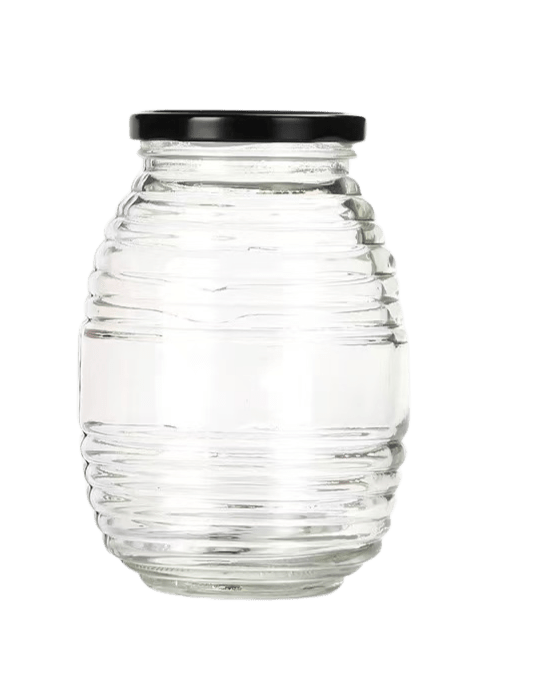
The 730ml Honey Glass Jar is one of the sizes we ship most often for bulk and refill-style honey programs, pairing a wide mouth for easy filling with a neck profile sized for standard lug or twist-off lids.
Hexagonal vs Round Honey Jars
Shape is the other major decision after capacity. Round jars are the default because they’re cheap to tool and fill at speed on standard lines, but hexagonal honey jars have become a popular upgrade for brands that want more shelf presence without commissioning a fully custom mold.
| Factor | Round jar | Hexagonal jar |
|---|---|---|
| Shelf stand-out | Standard, familiar | Higher — facets catch light and separate from round competitors |
| Label area | Fully curved, wrap-around label | Flat facets accept a flat label cleanly |
| Filling line speed | Fastest, most forgiving on standard fillers | Slightly slower orientation on some fillers; check compatibility first |
| Stacking / palletizing | Efficient with standard dividers | Can nest well due to flat sides, but confirm carton fit |
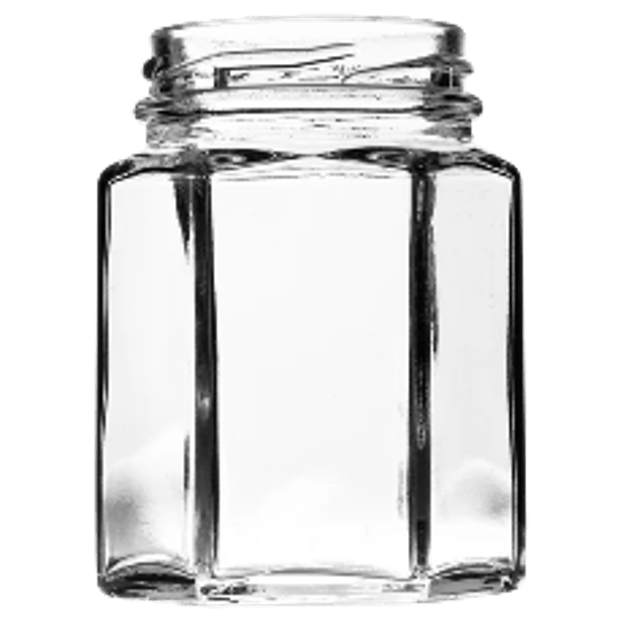
Our 110ml Hexagonal Glass Jar Tall is a good example of this format at a gift-size capacity: the flat facets give a honey brand a distinct look on a crowded shelf without the cost of a proprietary mold.
Neither shape is objectively better — the right call depends on whether your filling line has run hexagonal profiles before and whether your label artwork is designed for a curved or flat surface.
Choosing a Honey Packaging Supplier
Once shape and capacity are set, the harder decision is picking a honey packaging supplier that can actually deliver consistent quality at the volume you need. A few checks are worth doing before placing a first order:
- Stock mold vs private mold: stock honey jar shapes (round, hexagonal, Bonne Maman–style) ship faster and at lower MOQ than a brand-exclusive mold.
- Food-contact documentation: ask for the supplier’s food-contact compliance statement up front rather than after the first shipment lands.
- Closure compatibility: confirm the neck finish matches the lug cap or twist-off lid you plan to use — a mismatched finish is one of the most common (and most avoidable) delays in a first order.
- Sample lead time: a supplier that can turn around a physical sample quickly, rather than only a rendering, is a good signal for how they’ll handle production.
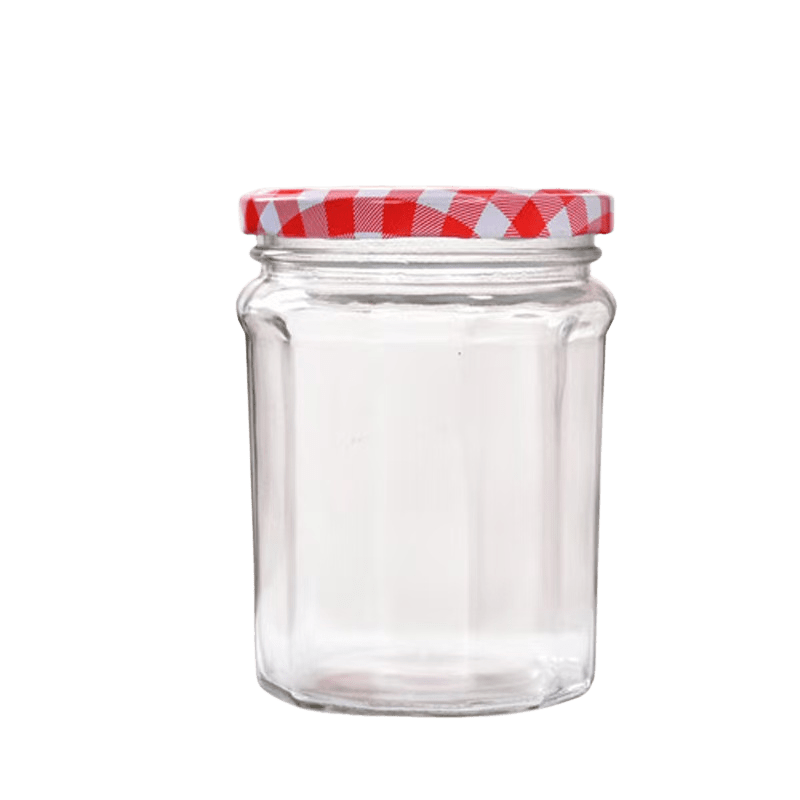
Brands that want a more traditional, vintage-preserve look sometimes choose a format like the 380ml Jam Glass Jar Bonne Maman instead of a dedicated honey jar shape — the wide mouth and gingham-friendly lid profile work just as well for honey as they do for jam.
자주 묻는 질문
What size glass honey jar should I start with?
Most new honey brands start with a 180ml or 380ml round jar because these sizes match standard retail shelf expectations and are the fastest to source at low minimum order quantities.
Are hexagonal honey jars more expensive than round jars?
Hexagonal honey jars are typically priced close to round stock-mold jars when ordered in similar volumes, since both are existing stock shapes rather than custom tooling; always confirm current pricing and MOQ directly with your supplier.
What lid type works with glass honey jars?
Lug caps and twist-off lids are the two most common closures for glass honey jars; the right choice depends on the neck finish of the jar and whether your filling line applies lids by torque or by lug rotation.
Can glass honey jars be used for creamed or infused honey?
Yes. Glass is inert and holds up well to the thicker consistency of creamed honey and to infusions with fruit, spices or herbs, since the glass itself won’t react with any added ingredients.
Do glass honey jars meet food-contact requirements for export?
Standard soda-lime glass jars are widely accepted as food-contact safe under both FDA and EU regulations; ask your supplier for their current food-contact compliance documentation before your first order.
 English
 French
 Spanish
 Portuguese
 German
 Italian
 Japanese
 Korean
 Arabic
 Russian