
A custom glass bottle is a container made in a mould cut specifically for one brand. It gives complete control over shape, embossing, weight and proportions, and it is the reason a premium spirit is recognisable across a bar from ten metres away. It also carries a one-off tooling cost, a minimum order quantity typically between 30,000 and 100,000 units, and a first-run lead time of 10 to 16 weeks. This guide covers the whole path — what glass can and cannot be made to do, what a mould costs and why, how the process actually runs, and the twelve pieces of information a manufacturer needs from you to quote accurately.
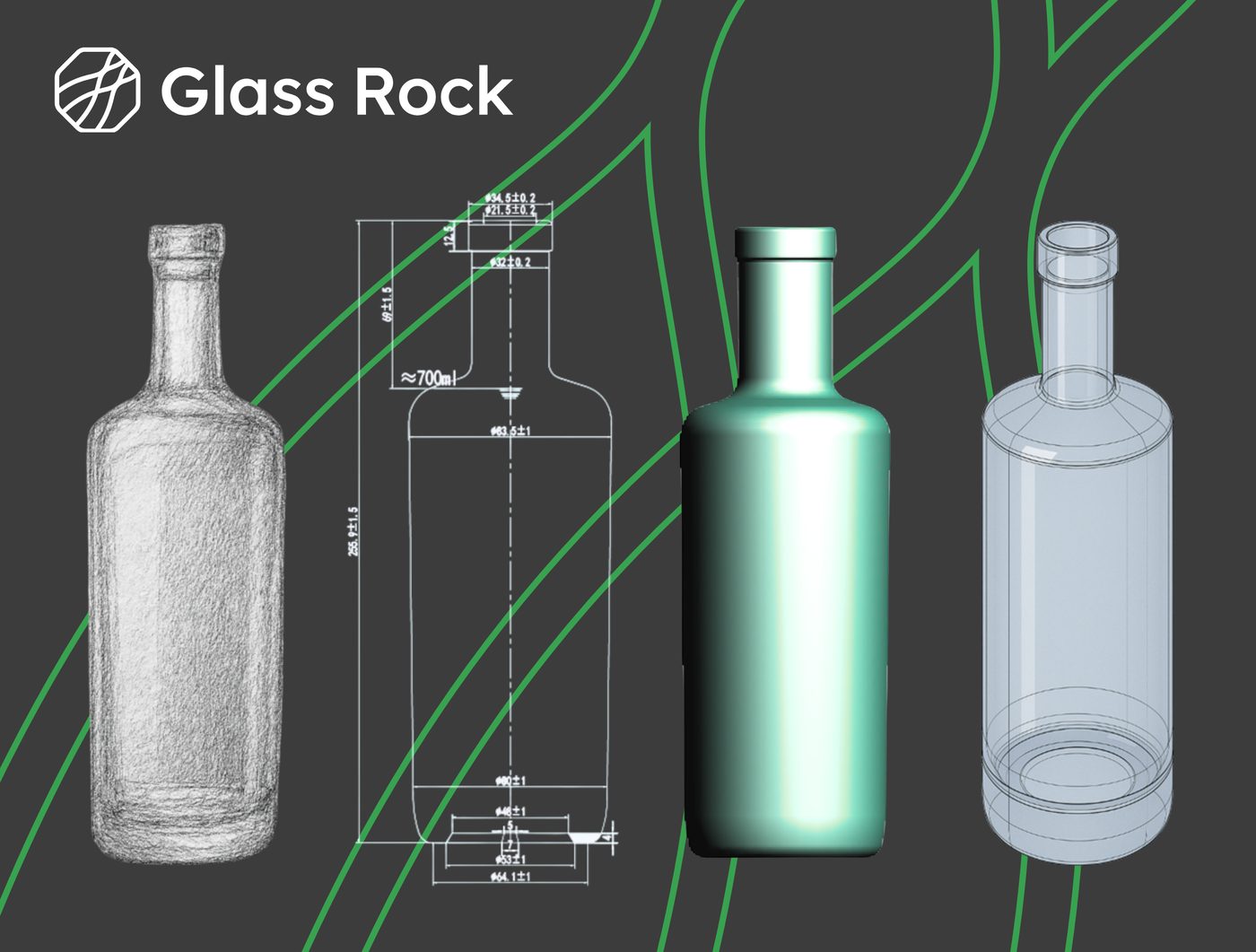
Custom or stock: the real decision
Almost every brand that asks for a custom bottle should first be sure it does not want a stock one. This is not a sales position — it is the honest arithmetic.
Spread across 100,000 bottles, a mould set adds a small amount per unit — usually a rounding error against the glass itself. Spread across 20,000 bottles it is a significant line item, and if the brand repositions in year two the tooling is a sunk cost.
The middle path is worth naming explicitly, because it is what most successful launches actually do: start on a stock bottle with distinctive decoration and closure, prove the volume, then tool. A well-chosen stock bottle with a screen-printed design, a frosted finish and a wooden bartop cork is not a compromise product — it is a considerable number of the bottles on a premium back bar.
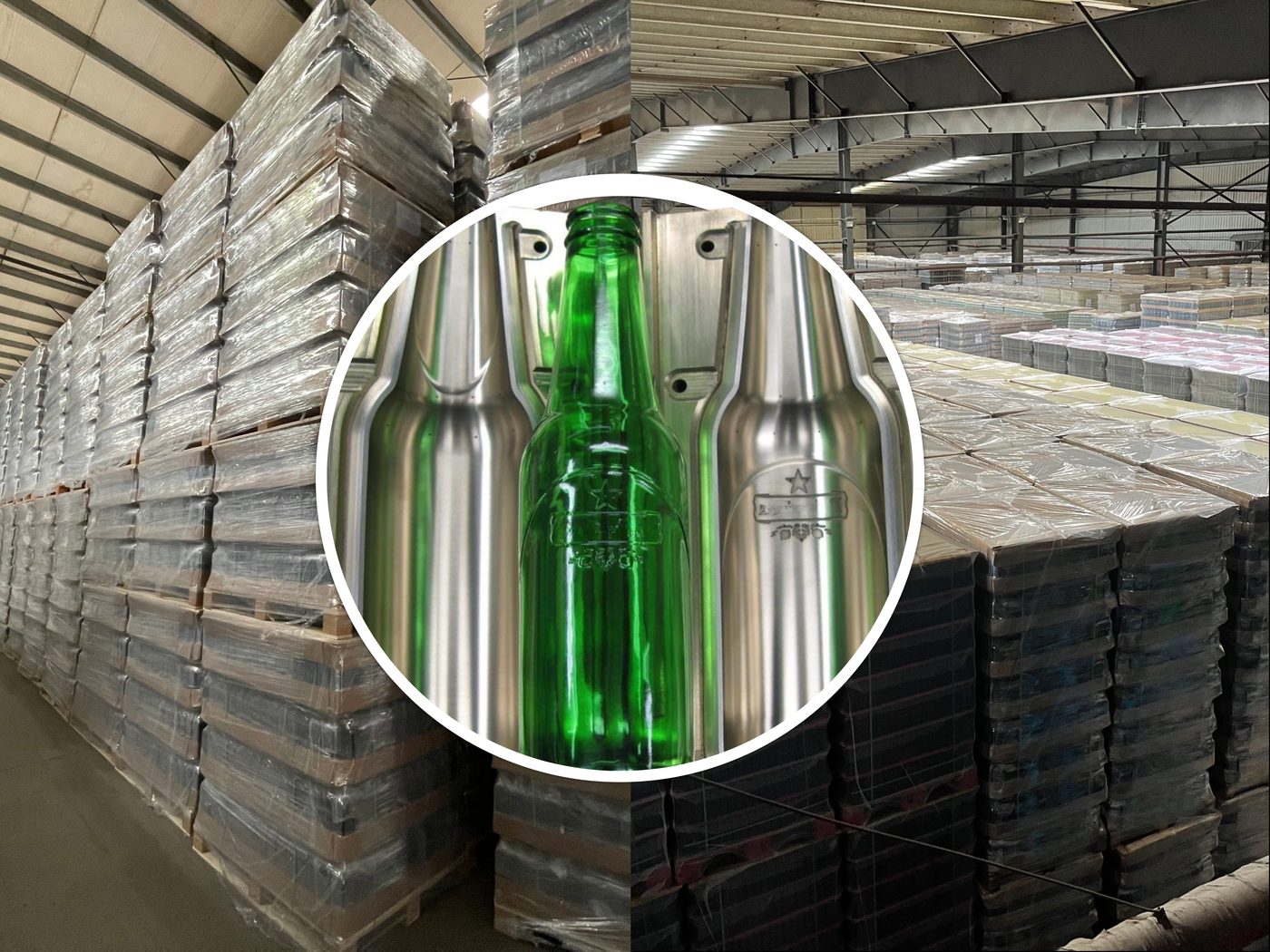
The eight stages of a custom bottle project
Two stages deserve expanding, because they are where the value and the risk sit.
The technical drawing
A concept render is not a specification. The document that governs the project is the technical drawing: overall height, maximum body diameter, brimful and nominal capacity, glass weight, neck finish designation, label panel dimensions, base profile and — critically — the tolerance on each. Glass shrinks as it cools and moulds wear over their life, so every dimension is a band, typically ±1 to ±2 mm. Cartons, labels and filling-line change parts must all be designed against the tolerance band, never the nominal figure. We cover this at length in the guide to reading packaging dimensions.
The design-for-manufacture review
Before any steel is cut, the design is checked against what glass forming can physically do. This is the stage that saves projects, and it is worth doing early — a DFM issue found at the drawing stage costs an email; the same issue found after mould trials costs a mould.
What glass can and cannot be made to do
Glass is formed by blowing or pressing molten material against a mould that must then open to release it. Everything that follows is a consequence of those two facts.
| Constraint | Why it exists | What to do instead |
|---|---|---|
| No undercuts | The mould has to open along a straight line | Re-profile so every surface draws cleanly; use decoration for the effect |
| No sharp internal corners | Molten glass will not flow into a sharp radius | Radius every edge; 3–5 mm is a usable starting point |
| A parting line is unavoidable | Two mould halves must meet somewhere | Place it deliberately — on an edge, a flute or under the label |
| Extreme height-to-diameter ratios | Glass thins unevenly on very tall, narrow bodies | Accept a heavier bottle, or moderate the proportion |
| Asymmetric shapes | Glass distributes unevenly, causing thin walls | Achievable but costs weight and yield; budget for it |
| Very thin embossing | Fine detail will not fill or will wear from the mould | Minimum stroke width around 0.8–1 mm, generous draft |
| Flat, wide bases | Glass sags; the bottle rocks | Design a push-up or a defined bearing ring |
None of these makes distinctive design impossible. Every recognisable bottle on the market obeys all of them. The constraint is craft, not creativity — and it is why an AI render or a designer’s concept always needs a manufacturing pass, a subject we cover in AI bottle design and the manufacturing reality.
Mould cost, MOQ and lead time
Three numbers govern the commercial case, and they are linked.
Mould cost depends on how many cavities you tool and how complex the shape is. A glass plant runs an IS machine with multiple sections, and each section needs its own blank and blow mould set. Tooling only one or two cavities is cheaper upfront but caps your output rate, which pushes up the per-bottle price; tooling the full machine costs more but produces at full speed. For most projects the practical answer is a partial set sized to the annual volume. Complexity matters too: a cylindrical bottle with light embossing is straightforward machining; a faceted, asymmetric shape with deep relief is not.
Minimum order quantity is set by physics, not policy. Changing moulds stops production on that section for hours. The MOQ is the volume over which that lost output, plus the colour campaign scheduling, becomes economic. Typical custom MOQs sit between 30,000 and 100,000 units depending on size and colour, and they are lower for common colours than for a special melt.
Lead time for a first run is usually 10 to 16 weeks from approved drawing: mould making is 4 to 6 weeks, sampling and approval 2 to 3, and then the bottle waits for a production slot in the right colour campaign. Repeat orders are much faster because the tooling exists — typically 4 to 8 weeks.
Colour and glass options
Colour is a functional specification as well as an aesthetic one, and it affects price and lead time.
| Colour | UV protection | Typical use | Note |
|---|---|---|---|
| Flint (clear) | None | Clear spirits, oils, cosmetics | Shows product; lower cullet ratio, so slightly higher impact |
| Extra flint | None | Luxury spirits and perfume | Very low iron, higher clarity, premium price — see flint grades |
| Antique green | Partial | Wine, olive oil | Widely available, high cullet tolerance |
| Amber | High, below ~450 nm | Beer, pharma, sensitive oils | Functional choice, not just traditional |
| Cobalt, black, custom melt | Varies | Design-led brands | Special melt: higher MOQ and longer lead time |
If a colour is central to your brand but the volume does not support a special melt, spray colouring on flint glass reaches almost any shade at a fraction of the commitment. It behaves differently in recycling streams, which is worth weighing if sustainability claims are part of your positioning.
Decoration and finishing
Decoration is where a stock bottle becomes a brand asset and where a custom bottle is finished. It is also, usefully, reversible: unlike tooling, you can change decoration between production runs.
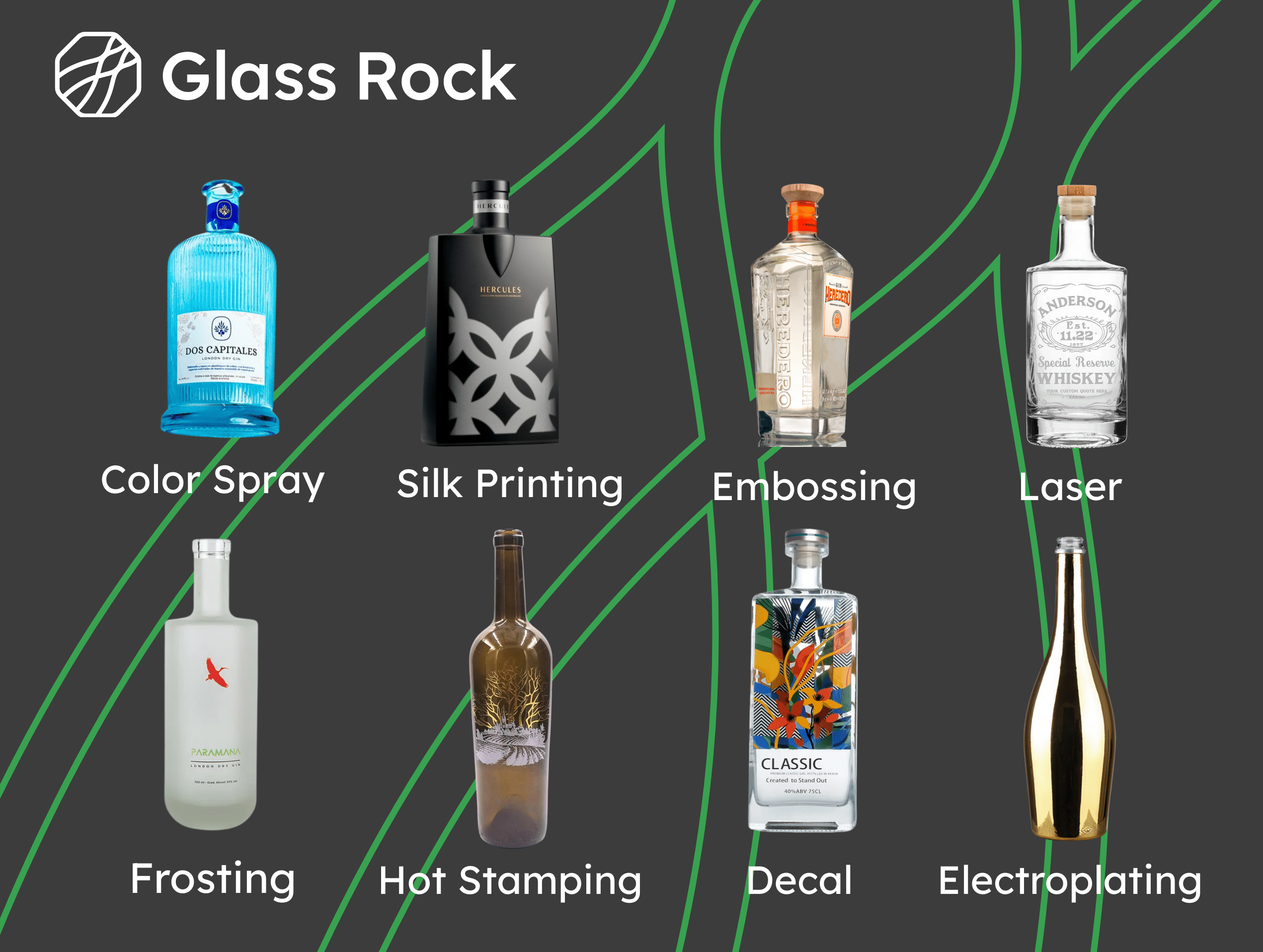
Screen printing (silk printing) applies ceramic or organic ink directly to the glass and is the workhorse of premium spirits: durable, sharp, and available in multiple colours at moderate cost. Frosting, whether acid-etched or sprayed, changes the whole tactile character of a bottle and pairs well with a printed motif. Embossing is moulded into the glass itself, so it is the one decoration that must be decided at tooling stage — it costs nothing per bottle thereafter. Hot stamping applies metallic foil for gold and silver detail. Electroplating and full colour spray transform the entire surface. Laser e decal cover fine detail and full-wrap photographic artwork respectively.
Two practical points. First, decoration interacts with cold end coating: excess coating lowers surface energy and can prevent inks and adhesives bonding, so tell the glass supplier your decoration method at quotation. Second, each technique carries its own minimum quantity, sometimes higher than the glass MOQ. Confirm both. There is more detail in our guide to glass bottle decoration techniques.
Closures and neck finish
The neck finish is formed first in the moulding cycle and cannot be reworked, which makes closure choice one of the earliest irreversible decisions in a custom project — not one of the last. A bartop cork finish and a threaded finish are different mould cavities.
Decide, in this order: the closure family (cork, screw, ROPP, crown), then the finish designation, then the liner against your product chemistry, then the capsule if any. The full decision framework and a six-step verification checklist are in the closure and neck finish compatibility guide.
Glass weight and sustainability
Glass weight is a specification you choose, and it is the single most consequential number in a custom bottle after capacity. It sets glass cost, freight cost, perceived quality and carbon footprint simultaneously — and those pull in opposite directions.
A heavy bottle signals premium in spirits, and many brands deliberately specify above the technical minimum for that reason. A lighter bottle costs less to make and less to ship, and cuts emissions roughly in proportion. Between the two sits a genuine trade-off that no supplier can settle for you, though two things help: press-and-blow forming distributes glass more evenly and allows a lighter bottle at equal strength, and proper coating removes the need to add glass as insurance against handling damage.
On the sustainability side, glass is infinitely recyclable without quality loss, and cullet ratio is the biggest energy lever in production. A brand can influence this at specification stage by choosing a colour that tolerates high cullet (amber and green) and by not over-specifying weight.
The brief: twelve fields to send a manufacturer
A quotation is only as good as the brief. These twelve fields let a manufacturer come back with a real price and lead time rather than a range:
- Product and category — gin, olive oil, serum, sauce. It determines almost everything else.
- Nominal fill capacity in millilitres, and whether brimful capacity matters.
- Target market — regulatory requirements and standard formats differ; see liquor bottle sizes by market.
- Annual volume, and the size of the first order.
- Glass colour, or the reference you want matched.
- Target glass weight, or the positioning if you do not have a figure.
- Closure family and finish, or the closure supplier’s drawing.
- Decorazione methods and number of colours.
- Label type and panel dimensions required.
- Filling line constraints — max height, neck handling, bulk or cased.
- Existing artwork or reference bottle, even a photograph.
- Target date for first delivery, and whether it is fixed.
If you have a design, send it in any form — a sketch, a render, a competitor bottle you like. Manufacturers work from all three routinely.
Frequently asked questions
How much does a custom glass bottle mould cost?
It depends on the number of cavities tooled and the complexity of the shape, and it is a one-off cost rather than a per-bottle one. A simple cylindrical bottle with light embossing tools far more cheaply than a faceted asymmetric design with deep relief. Ask for the quotation to state the cavity count, because a cheap mould quote often means a low cavity count and therefore a higher price per bottle.
What is the minimum order quantity for custom bottles?
Typically 30,000 to 100,000 units, depending on size and colour. The MOQ exists because changing moulds stops production on that machine section for hours, and the glass plant runs colour campaigns. Common colours have lower minimums than special melts.
How long does a custom bottle project take?
Around 10 to 16 weeks from approved technical drawing to first pallet: 4 to 6 weeks for mould making, 2 to 3 for sampling and approval, then a wait for the right colour campaign. Repeat orders on existing tooling run 4 to 8 weeks.
Can you make any shape in glass?
Almost, within four rules: no undercuts, since the mould must open; no sharp internal corners, because molten glass will not fill them; moderate height-to-diameter ratios, or wall thickness becomes uneven; and a parting line somewhere, which you can place but not eliminate. Every recognisable bottle on the market works within these.
Do I own the mould?
Practice varies by manufacturer, and it is worth settling in writing before you pay. Clarify who owns the tooling, who owns the design, whether the mould can be transferred to another plant, and how long it will be stored if you pause production. These questions are cheap to ask at the quotation stage and awkward to raise later.
Can I get a sample before committing to production?
Yes, and you should never approve a mould without one. The sequence is technical drawing, then a 3D render or 3D-printed model to check proportions in the hand, then first glass from the mould trial. Approve on the physical glass sample, not on the render.
What is the difference between a custom bottle and a custom decoration?
A custom bottle means a mould cut for you: the shape itself is exclusive. Custom decoration means printing, frosting, colouring or stamping applied to a bottle that may be a stock shape. Decoration is far cheaper, far faster, and reversible between runs — which is why it is the right starting point for most launches.
Can I emboss my logo into the glass?
Yes, and it costs nothing per bottle once the mould exists — but it must be decided at tooling stage because it is cut into the mould. Keep stroke widths at roughly 0.8 mm or above with generous draft angles; very fine detail will not fill and will wear away over the mould’s life.
Which is heavier, and does it matter?
Glass weight is specified, not fixed. Heavier signals premium in spirits and many brands choose that deliberately; lighter cuts glass cost, freight cost and emissions in roughly equal proportion. Press-and-blow forming and proper surface coating both let you go lighter without losing strength.
Can I match a competitor’s bottle?
You can match a capacity, a colour, a finish and a general silhouette — those are not protectable. You cannot copy a distinctive registered shape or trade dress, and a reputable manufacturer will decline to. Send the reference bottle as a starting point and expect the design to move away from it.
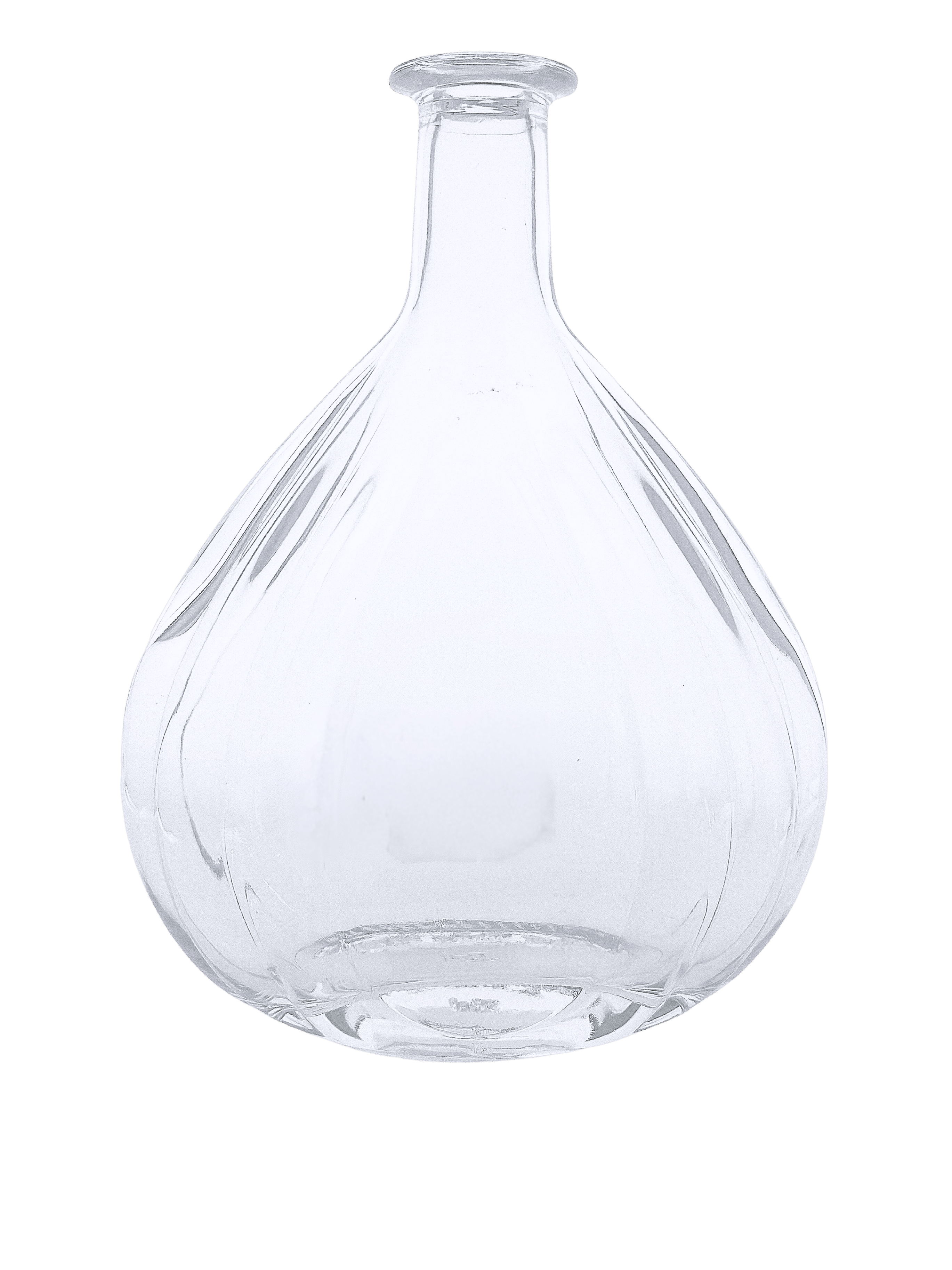
Custom-capable GlassRock bottle families
Related guides
- Perfume and cologne bottle sizes: mL, ounces and how long they last
- What is borosilicate glass? Properties, uses and when you need it
- How glass bottles are made: the complete production process
- Bottle closure types and neck finish compatibility
- Glass bottle decoration techniques explained
- Glass bottle coatings: hot end, cold end and anti-scratch
- AI bottle design and the manufacturing reality
- L×W×H explained: reading packaging dimensions
- Liquor bottle sizes: the complete reference
- The different grades of flint glass in bottle production


 English
 French
 Spanish
 Portuguese
 German
 Italian
 Japanese
 Korean
 Arabic
 Russian