
Glass bottles are made by melting a batch of silica sand, soda ash, limestone and recycled cullet at roughly 1,550 °C, cutting the molten glass into precisely weighed gobs, forming each gob into a bottle inside a two-stage mould on an IS (individual section) machine, then cooling the bottle slowly in an annealing lehr to remove internal stress. Surface coatings, automated inspection and palletising complete the line. A modern plant repeats this cycle several hundred times a minute, and the whole journey from raw sand to a packed pallet takes about 24 to 36 hours.
What glass is actually made of
Container glass is soda-lime glass, and it has been essentially the same recipe for two thousand years. Three raw materials do almost all the work, and a fourth — recycled glass — increasingly replaces them.
Silica sand is the glass former. On its own, silica melts at about 1,700 °C, which is impractical to sustain industrially. Soda ash (sodium carbonate) is the flux: it drops the melting point to a workable 1,400–1,600 °C. But soda ash alone would make glass water-soluble — literally, it would dissolve. Limestone (calcium carbonate) is the stabiliser that makes the finished glass chemically durable, which is why a glass bottle can hold acidic wine or alkaline detergent for years without the container and the contents interacting.
Smaller additions fine-tune the result: alumina improves chemical resistance, magnesia adjusts viscosity during forming, and metal oxides give colour. Iron and chromium produce green; iron plus sulphur and carbon produce amber; the near-total absence of iron produces the water-clear glass sold as extra flint.
Cullet: the ingredient that changes the economics
Cullet is crushed recycled glass, and it is the single most important variable in a modern furnace. It melts at a lower temperature than raw batch, so every 10% of cullet substituted into the mix cuts furnace energy consumption by roughly 2.5% and CO2 emissions by about 5%. Amber and green production regularly runs at 60–90% cullet. Flint is more constrained: any coloured contamination shows immediately in clear glass, so flint furnaces typically run much lower cullet ratios and demand tightly sorted feedstock.
This is why colour affects price and lead time as much as it affects appearance. A green bottle and a flint bottle of identical geometry are not equivalent products to the plant that makes them.
Step 1 — The batch house: weighing and mixing
Raw materials arrive by bulk truck or rail and are stored in silos. The batch house weighs each component to a tolerance measured in fractions of a percent, then mixes them into a homogeneous batch. Accuracy here is not a formality: a batch that drifts a few percent off-recipe changes the glass viscosity, which changes how it flows in the mould, which changes wall thickness distribution in the finished bottle.
The mixed batch is conveyed to the doghouse — the charging end of the furnace — where it is fed in continuously alongside the cullet.
Step 2 — The furnace: melting at 1,550 °C
A container-glass furnace is a refractory-lined bath holding several hundred tonnes of molten glass. It runs continuously for 8 to 15 years without ever being allowed to cool, because heating and cooling the refractory is what destroys it. A furnace campaign ends with a full rebuild, not a shutdown.
Inside, the batch floats on the surface of the existing melt and gradually dissolves into it. Temperature peaks around 1,500–1,600 °C. The glass then spends roughly 24 hours in the tank, which is not wasted time — it is the refining stage, where dissolved gases rise out as bubbles and the melt becomes chemically and thermally homogeneous. Rush this and you get seeds (tiny bubbles) and cord (density striations) in the finished bottle.
Most plants use regenerative end-port or side-port furnaces fired on natural gas, recovering exhaust heat through refractory checker chambers to preheat combustion air. Electric boosting is common; fully electric and hydrogen-ready furnaces are the direction of travel for decarbonisation, though they remain a minority of installed capacity.
Step 3 — Conditioning and the gob
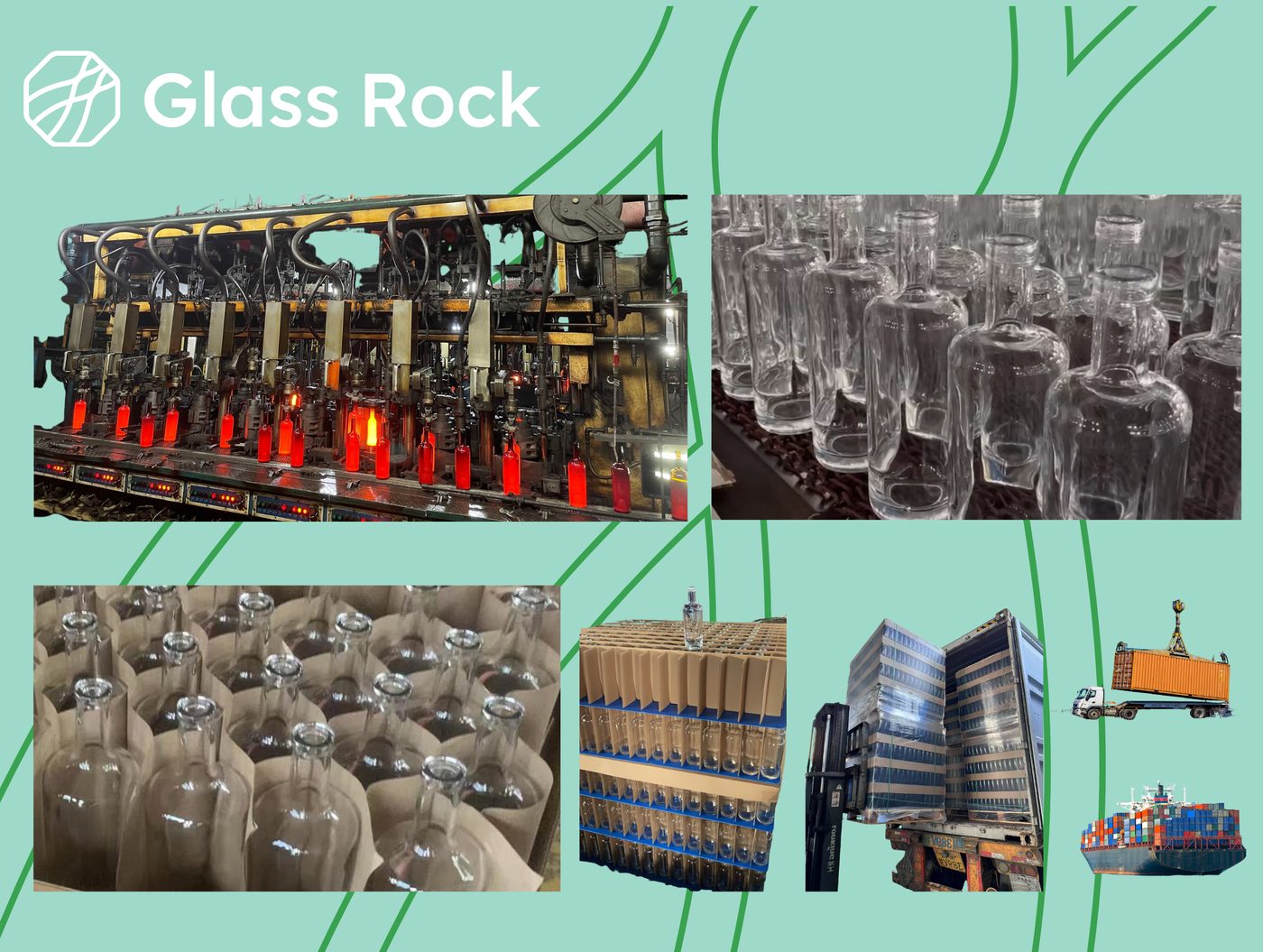
Molten glass leaves the furnace through the forehearth, a long channel that cools it under tight control to about 1,050–1,200 °C — the temperature at which glass has the honey-like viscosity needed for forming. Thermal uniformity across the forehearth matters enormously: a few degrees of variation across the stream produces bottles with uneven wall thickness.
At the end of the forehearth, a plunger mechanism pushes glass through an orifice ring and rotating shears cut it into gobs — cylinders of molten glass weighed to within a gram or two of target. The gob weight is the bottle weight. A 750 mL spirits bottle specified at 550 g starts life as a 550 g gob. Gobs drop through chutes into the forming machine below.
Step 4 — Forming in the IS machine
The individual section (IS) machine is the heart of the plant. It is a row of 6 to 20 identical sections, each operating independently on its own timing, each producing bottles in parallel. Because the sections are independent, one can be stopped for a mould change while the rest keep running — which is precisely why the design has dominated the industry since the 1920s.
Every section forms the bottle in two stages, using two moulds: a blank mould that makes a rough pre-form called the parison, and a blow mould that gives the final shape. Two methods get from gob to parison.
Blow-and-blow
Compressed air does all the work. A settle blow pushes glass down into the finish (the neck and sealing surface, which is formed first and never touched again), then a counter blow inflates the parison from below. The parison is inverted into the blow mould and a final blow expands it against the mould wall. This is the standard method for narrow-neck containers: spirits, wine, beer, oils.
Press-and-blow
A metal plunger physically presses the gob into the blank mould instead of using air. Because the plunger contacts the glass directly, wall thickness is controlled far more precisely — which means a lighter bottle at equal strength. Press-and-blow is standard for wide-mouth jars, and narrow-neck press-and-blow (NNPB) is the technology behind most modern lightweight bottle programmes. It cannot be used when the neck is too narrow to admit a plunger.
The mould: where your bottle design actually lives
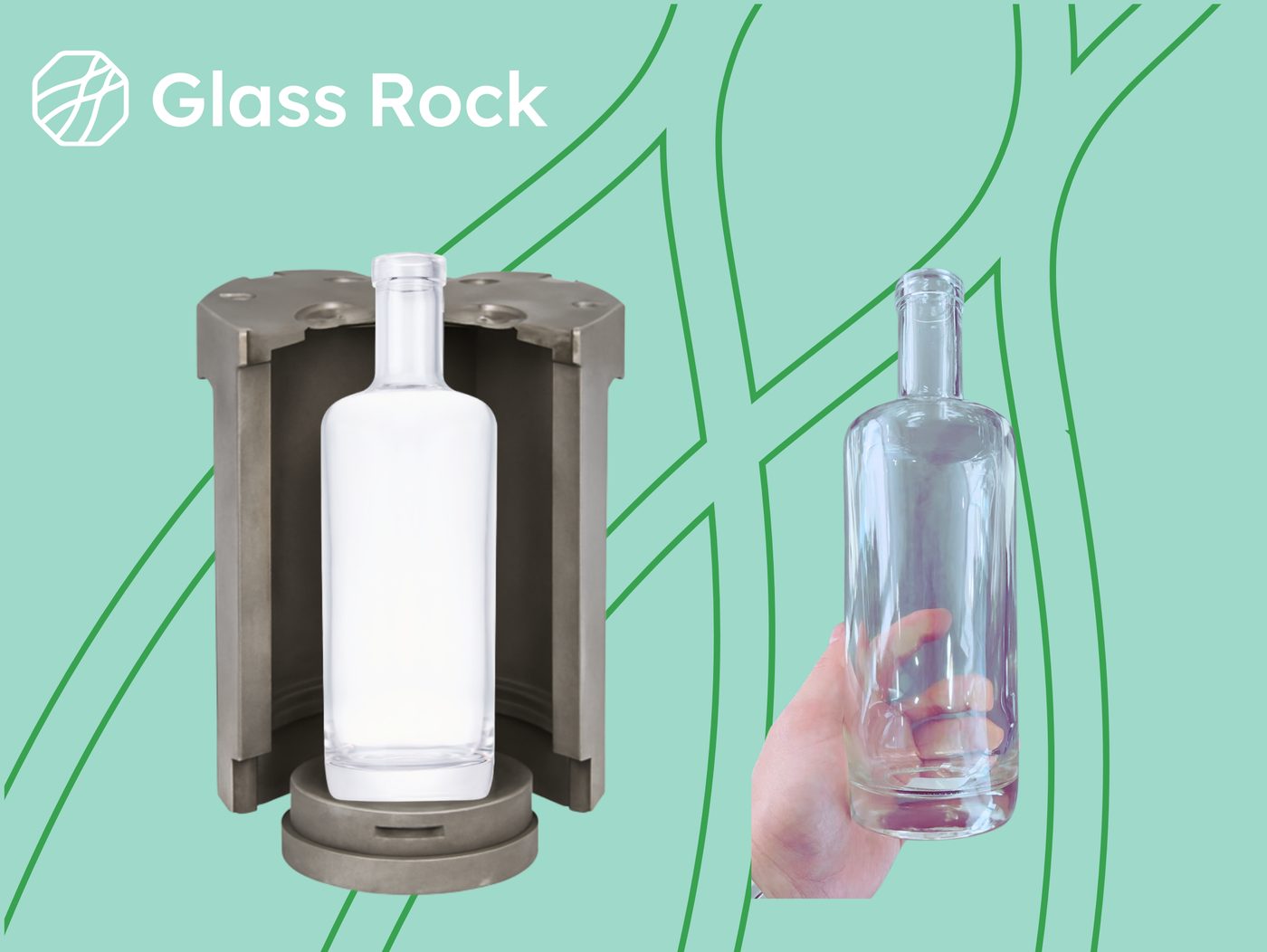
Moulds are machined from cast iron or bronze alloys and are consumable tooling: a set produces a few hundred thousand to a few million bottles before it needs refurbishment or replacement. Mould temperature is controlled by forced air — too hot and the glass sticks, too cold and it chills before filling the cavity.
Two constraints from this stage explain most of what a designer can and cannot do with glass. First, the mould must open, so every custom shape carries a parting line where the two halves meet — you can place it, you cannot eliminate it. Second, glass will not flow into sharp internal corners; every edge needs a radius. We cover these limits in detail in the guide to custom glass bottle manufacturing.
Step 5 — Annealing: the invisible step that decides whether the bottle survives
A bottle leaving the blow mould at roughly 500 °C looks finished. It is not. Its surface has cooled faster than its core, and that differential locks residual stress into the glass. Left untreated, the bottle may crack for no visible reason — on the filling line, in transport, or in a customer’s hand.
The annealing lehr is a long tunnel oven that fixes this. Bottles are reheated to around 550 °C, held there so internal stresses relax, then cooled on a controlled ramp over 45 to 90 minutes. Above the annealing point stress relaxes freely; below the strain point (around 500 °C) the shape is permanently set and cooling can safely accelerate to reach roughly 60 °C at the lehr exit.
Annealing quality is measured with polarised light, which makes residual stress visible as coloured fringes. It is worth asking any supplier how they verify it, because annealing defects are the classic failure that passes visual inspection and shows up later at your cost.
Step 6 — Surface coatings
Two coatings are applied in-line, and both exist for the same reason: glass is strong until it is scratched. A pristine glass surface has high theoretical strength; a single line of abrasion damage from bottle-to-bottle contact creates a stress concentrator that can cut practical strength by half.
The hot end coating goes on at about 500–600 °C as bottles exit the forming machine, before the lehr. A tin or titanium precursor vapour reacts with the hot surface to deposit an extremely thin metal-oxide layer that bonds chemically to the glass. The cold end coating — a polyethylene or oleic-acid based lubricant — is sprayed at around 100–140 °C at the lehr exit. It gives the surface lubricity so bottles slide past each other instead of grinding.
Neither works alone: the hot end layer provides the anchor, the cold end layer provides the slip. The full mechanism, the measurement units and the food-contact implications are covered in the dedicated guide to hot end and cold end coatings.
Step 7 — Inspection and quality control
Every bottle is inspected — not a sample, every one. Modern lines combine several technologies:
- Optical inspection: multi-camera stations photograph each bottle from several angles, detecting bird-swings, stones, blisters, checks and finish defects at line speed.
- Dimensional gauging: height, diameter, verticality, and critically the finish geometry, since a neck out of tolerance will not seal.
- Wall thickness measurement: infrared or capacitive sensors verify glass distribution around the circumference.
- Squeeze and pressure testing: mechanical load applied to confirm strength, destructive on samples.
- Polarised light: residual stress left by annealing.
Rejected ware is not waste — it goes straight back into the furnace as internal cullet, which is why glassmaking scrap rates are economically tolerable in a way that plastic or metal scrap is not.
Step 8 — Packing and palletising
Bottles are either bulk-palletised (layers separated by sheets, stretch-wrapped) or packed in cartons with partitions, depending on the customer’s filling line. This choice is worth deciding early: bulk palletising is cheaper and denser, but requires a depalletiser at the filling plant. Case dimensions, layer patterns and pallet configuration then determine your freight cost — the arithmetic is laid out in our guide to packaging dimensions and pallet fit.
Types of glass and why bottles are coloured
| Type | Composition | Used for | Note |
|---|---|---|---|
| Soda-lime | ~72% silica, 13% soda, 10% lime | Virtually all bottles and jars | Inexpensive, fully recyclable, chemically durable |
| Borosilicate | Silica + boron trioxide | Laboratory ware, some pharma | Very low thermal expansion; far more expensive |
| Type I / II / III (pharma) | Classification by chemical resistance | Injectables, oral liquids | Regulatory classes, not compositions as such |
Colour is functional as well as aesthetic. Amber blocks the majority of UV and blue light below roughly 450 nm, which is why beer — highly susceptible to light-struck off-flavours — is packed in it. Green offers partial protection and is traditional for wine and olive oil. , offers essentially none, and is chosen when product visibility outweighs light protection, as with most clear spirits.
Is glass sustainable?
Glass is infinitely recyclable with no loss of quality — a genuine closed loop, which is unusual. The honest counterweight is that melting is energy-intensive and glass is heavy, so transport emissions are significant. The sustainability case therefore rests on three levers: cullet ratio (the single biggest energy lever), lightweighting (less glass per bottle, achieved largely through NNPB forming), and proximity or reuse systems. Returnable bottle schemes, where the infrastructure exists, outperform single-use recycling by a wide margin — the trade-offs are quantified in our analysis of returnable beer bottle systems.
What this means when you buy bottles
Understanding the process changes the questions you ask a supplier. Five things follow directly from how glass is made:
- Lead times are set by the furnace, not the office. A plant runs colour campaigns — weeks of amber, then weeks of flint. If you need green and the furnace is running flint, you wait for the campaign, not for a production slot.
- Minimum order quantities are physics, not policy. A mould change costs hours of lost output across a section. MOQs exist to amortise that.
- Tolerances are real. Glass shrinks as it cools and moulds wear. Expect ±1–2 mm on height and diameter depending on size. Design your cartons and labels against the tolerance band, never the nominal figure.
- The finish is formed first and cannot be reworked. Neck finish specification is the least forgiving part of a bottle order — see the closure and neck finish compatibility guide.
- Weight is a specification, not a by-product. Ask for gob weight and its tolerance. It determines glass cost, strength and freight in one number.
Frequently asked questions
What is glass made from?
Container glass is made from silica sand (about 72%), soda ash (about 13%), limestone (about 10%) and minor oxides, plus recycled cullet which can substitute for 30–90% of that raw batch. Sand forms the glass network, soda ash lowers the melting temperature, and limestone makes the result chemically durable.
At what temperature does glass melt?
Pure silica melts near 1,700 °C. Adding soda ash brings the working melting range of container glass down to roughly 1,400–1,600 °C, with furnaces typically operating at a peak around 1,550 °C. Glass has no sharp melting point — it softens progressively over a range, which is what makes forming possible.
How long does it take to make a glass bottle?
The forming itself takes seconds: an IS machine section produces a bottle roughly every 2–8 seconds, and a full machine can exceed 500 bottles a minute. But the glass spends about 24 hours refining in the furnace and 45–90 minutes in the annealing lehr, so the end-to-end journey from raw sand to a packed pallet is around 24 to 36 hours.
Why do glass bottles have a seam?
Because the mould must open to release the bottle. The two mould halves meet along a parting line, and a faint seam is the trace of that joint. It can be positioned discreetly and minimised by good tooling, but it cannot be eliminated on a moulded container.
What is annealing and why does it matter?
Annealing is controlled slow cooling in a lehr. It removes the residual stress created when a bottle’s surface cools faster than its core. Poorly annealed bottles look normal but fail unpredictably later — often on the filling line. Residual stress is verified using polarised light.
Is glass recyclable?
Yes, and uniquely so: glass can be recycled endlessly without degrading, unlike plastic which loses polymer quality with each cycle. Recycled glass (cullet) melts at a lower temperature than raw batch, so recycling saves energy directly. The constraint is colour sorting — contamination is far more visible in flint than in amber or green.
What is the difference between soda-lime and borosilicate glass?
Soda-lime glass is the standard for bottles and jars: inexpensive, durable and fully recyclable, but with relatively high thermal expansion. Borosilicate glass contains boron trioxide, which drastically reduces thermal expansion and lets it survive rapid temperature changes. It is used for laboratory glassware and some pharmaceutical packaging, and costs substantially more.
Why are beer bottles brown?
Amber glass filters most ultraviolet and blue light below about 450 nm. That wavelength range triggers a reaction with hop-derived compounds producing the light-struck, or skunky, off-flavour. Green glass gives partial protection; clear glass gives essentially none, which is why clear-bottled beers rely on modified hop extracts or secondary packaging.
How many bottles can a glass factory produce per day?
A single furnace with its forming machines typically produces between 300,000 and 1,500,000 containers per day, depending on furnace pull rate, bottle weight and machine configuration. Lighter, smaller containers run faster; heavy premium spirits bottles run considerably slower.
What is cullet?
Cullet is crushed recycled glass fed into the furnace alongside raw materials. It comes from two sources: internal cullet (rejected bottles from the plant’s own line) and external cullet (post-consumer collected glass). Because it melts at a lower temperature than raw batch, each 10% increase in cullet ratio reduces furnace energy use by roughly 2.5%.
Can any bottle shape be manufactured in glass?
No. Glass forming imposes real limits: the mould must open, so undercuts are impossible; sharp internal corners will not fill and need radii; extreme height-to-diameter ratios cause uneven wall thickness; and asymmetric shapes create glass distribution problems. A design review before mould cutting is the standard way to catch these issues.
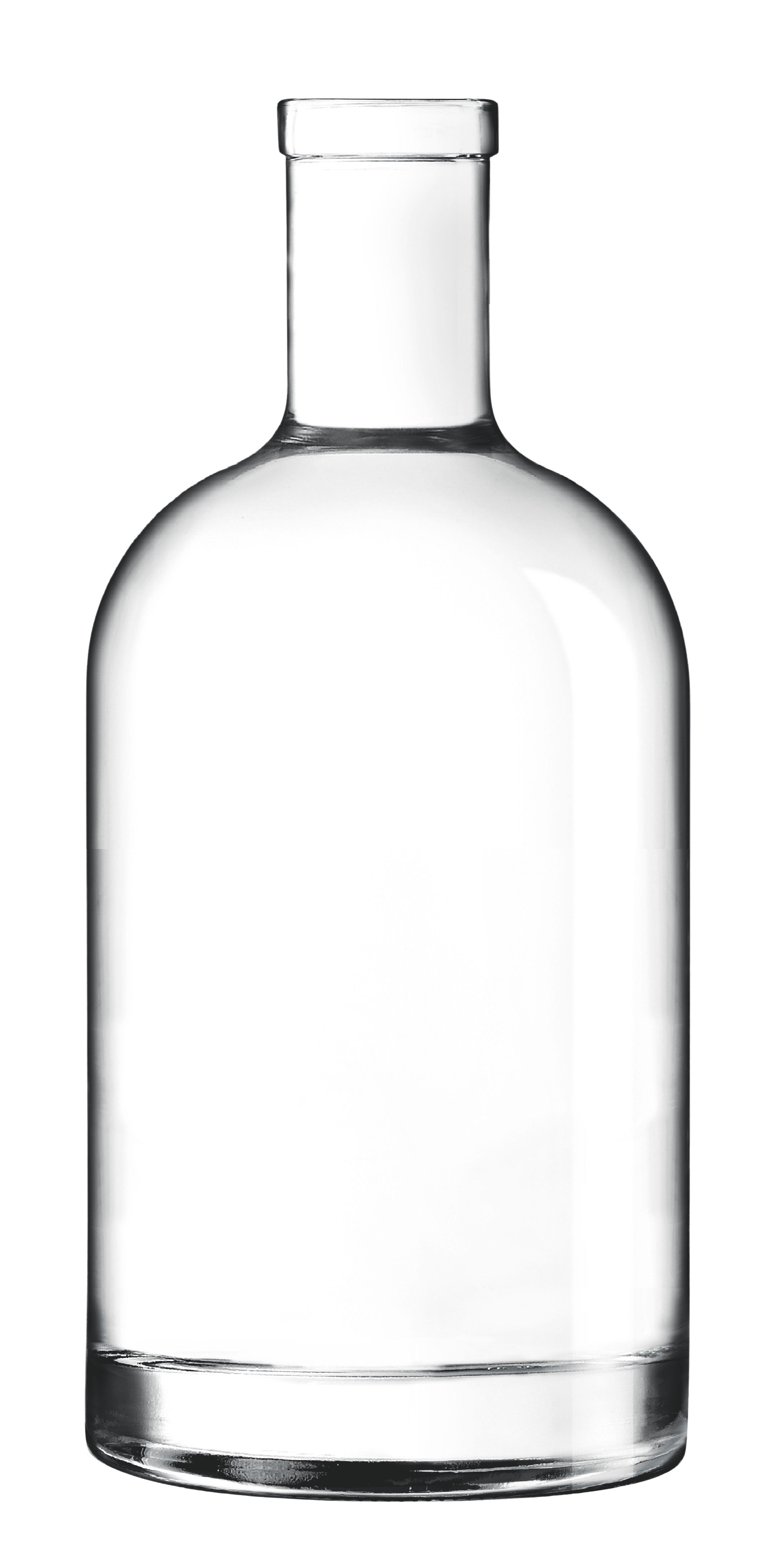
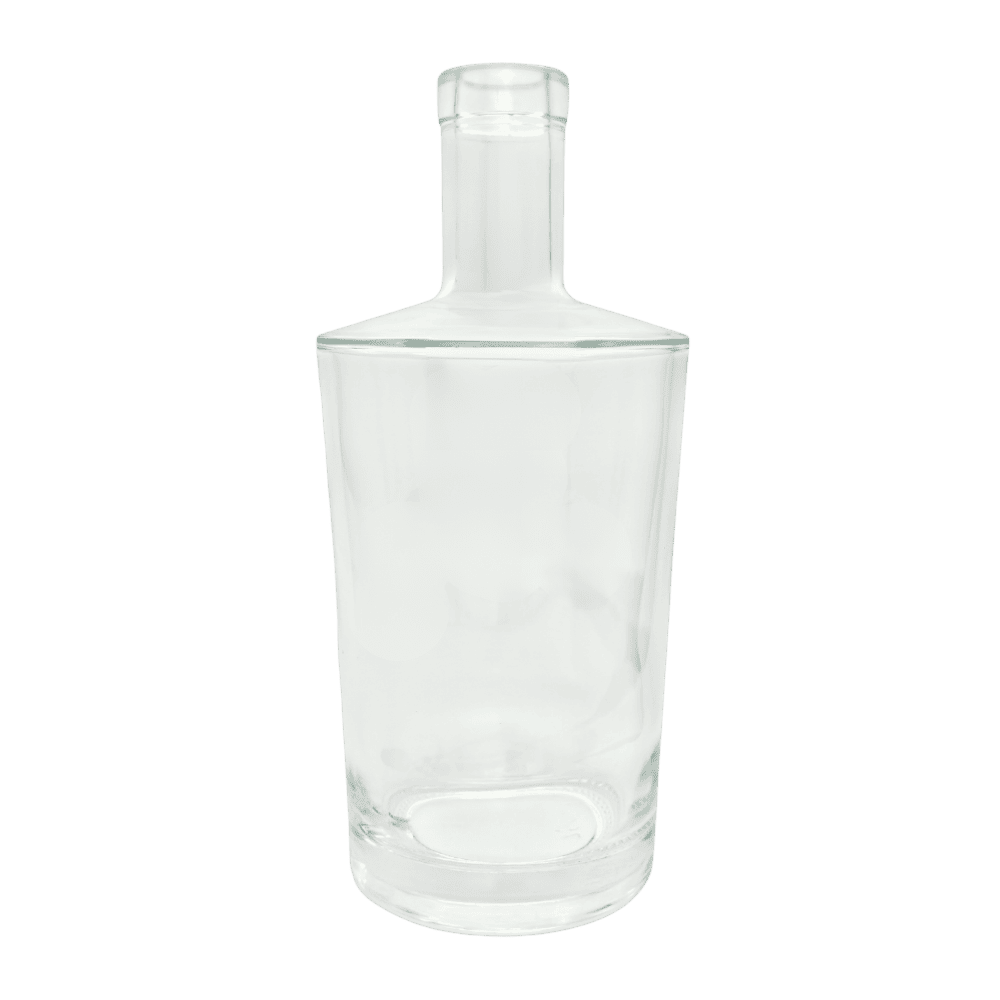
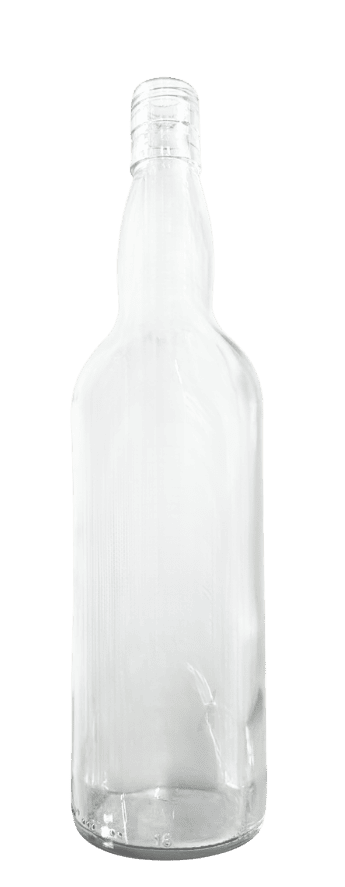
GlassRock bottles made on this process
Related guides
- What is borosilicate glass? Properties, uses and when you need it
- Is glass microwave, oven, dishwasher and freezer safe?
- Hot end and cold end coatings on glass bottles, explained
- Bottle closure types and neck finish compatibility
- Custom glass bottles: the complete manufacturing guide
- The different grades of flint glass in bottle production
- Liquor bottle sizes: the complete reference
- L×W×H explained: reading packaging dimensions


 English
 French
 Spanish
 Portuguese
 German
 Italian
 Japanese
 Korean
 Arabic
 Russian