
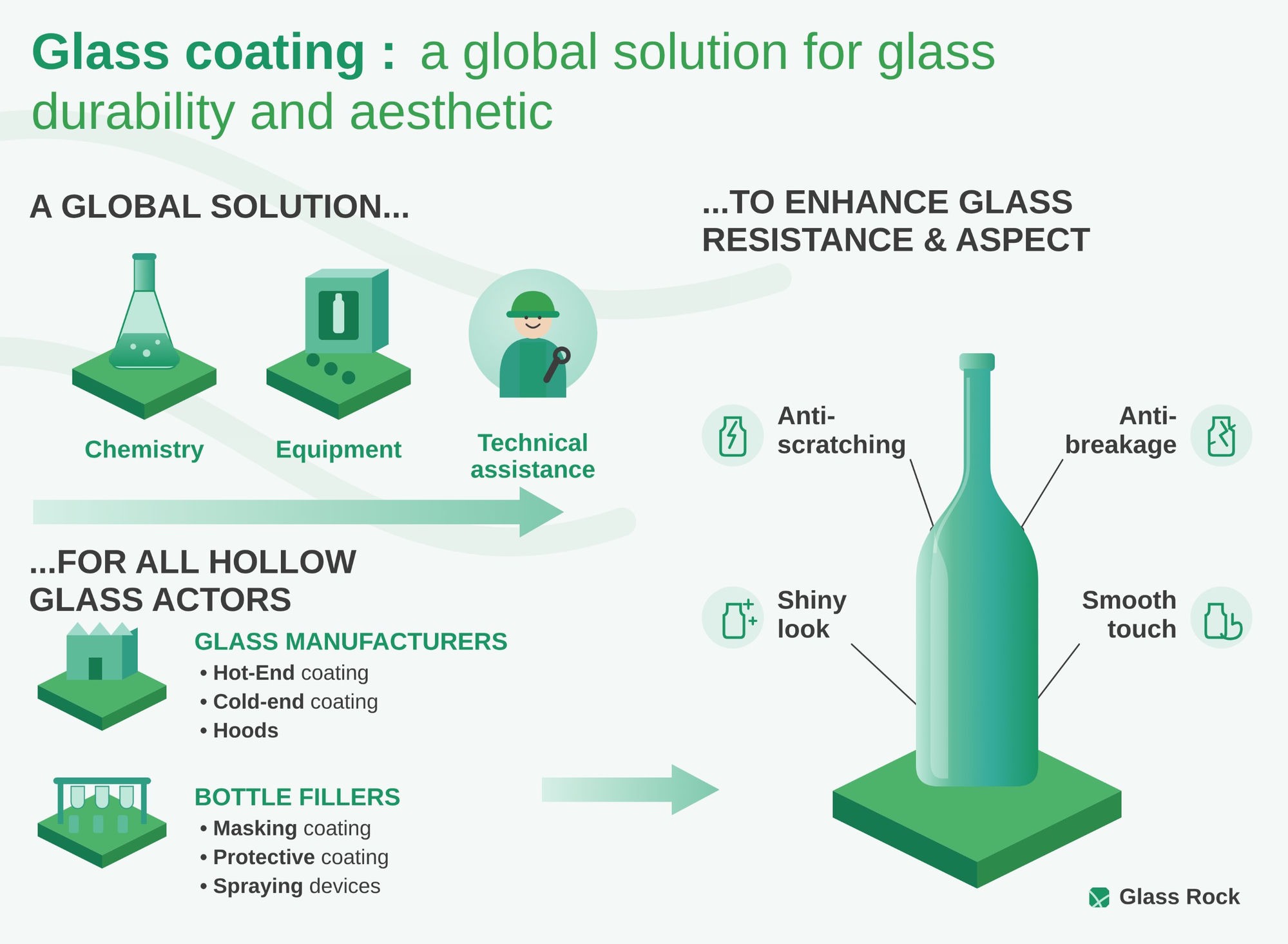
Glass bottles receive two coatings on the production line, and they do different jobs. The hot end coating is a nanometre-thin layer of tin or titanium oxide applied at 500–600 °C, immediately after forming, that bonds chemically to the glass. The cold end coating is a polyethylene or oleic-acid lubricant sprayed at 100–140 °C at the annealing lehr exit, which makes the surface slippery. Together they stop bottles scratching each other in handling. Neither works without the other, and the reason it matters is blunt: a scratched bottle can lose more than half its practical strength.
Why glass needs a coating at all
Glass is, in theory, an extraordinarily strong material. Its theoretical tensile strength exceeds that of steel. In practice a glass bottle breaks at a small fraction of that figure, and the reason is entirely about the surface.
Glass fails from surface flaws, not from bulk weakness. Every scratch, scuff and abrasion mark is a stress concentrator: applied load focuses at the tip of the flaw and a crack propagates from there. A bottle that has rubbed against its neighbours on a conveyor has acquired hundreds of these micro-flaws, usually in a visible band around the shoulder or the heel — the classic scuff ring.
This has a direct commercial consequence. A brand can specify heavier glass to compensate for handling damage, paying for extra weight in both raw material and freight. Or it can specify properly coated bottles and keep the weight down. Coating is the cheaper answer by a wide margin, and it is the reason lightweight bottle programmes are viable at all.
Where the coatings sit on the line
Understanding the sequence explains most of the practical questions. The hot end coating must be applied while the glass is still hot enough for the oxide to form a chemical bond — below roughly 450 °C, the reaction does not proceed properly. The cold end coating must wait until the surface has dropped below about 150 °C, or the organic lubricant simply burns off. Between the two sits the annealing lehr, which is why the two applications are physically separated by the length of the plant.
Hot end coating: the bonding layer
The hot end coating (HEC) is applied in a coating hood that bottles pass through seconds after leaving the blow mould, still glowing. A vapour of an organometallic precursor — most commonly monobutyltin trichloride (MBTC), sometimes titanium tetrachloride — is introduced into the hood. On contact with the hot glass surface it pyrolyses, depositing a continuous layer of tin dioxide (SnO2) or titanium dioxide.
That layer is astonishingly thin. It is measured in CTU (Coating Thickness Units), where 1 CTU is approximately 0.25 nanometres of tin oxide. Typical container specifications call for 20 to 60 CTU on the body, which is between 5 and 15 nanometres — a few dozen atoms thick. It is completely invisible and adds no measurable weight.
What the hot end coating actually does
- It creates an anchor. The metal-oxide surface has the chemistry the cold end lubricant needs to bond to. Bare glass does not hold the lubricant.
- It heals nothing, but it protects. The layer bridges nascent surface flaws and reduces the rate at which new ones propagate.
- It is permanent. Because the bond is chemical, hot end coating survives washing, pasteurisation and repeated handling. This is what makes returnable bottle systems possible.
Too little coating and the cold end layer will not adhere. Too much — typically above 80–100 CTU — and the surface develops a faint iridescent bloom that is visible on flint glass, and label adhesion can start to suffer. Coating is a controlled window, not a more-is-better parameter.
Cold end coating: the lubricating layer
The cold end coating (CEC) is sprayed or applied as a vapour at the lehr exit, at 100–140 °C. It is an organic lubricant, typically one of three families:
| Family | Characteristics | Typically used for |
|---|---|---|
| Polyethylene emulsion | Highest lubricity, good durability, most common | Beer, soft drinks, general one-way ware |
| Oleic acid / stearate | Lower cost, less durable, easier to remove | Ware that will be washed or heavily decorated |
| Polyethylene + silicone blends | Very high slip, specialised | High-speed lines, tight-pitch conveyors |
The cold end layer is measured not in thickness but in coefficient of friction. A typical target is a static coefficient of friction between glass surfaces of 0.2 to 0.4. Below 0.2 the bottles are so slippery they can become unstable on the conveyor and topple; above about 0.6 they grind and scuff. As with the hot end, the specification is a window.
Unlike the hot end coating, the cold end layer is not permanent. It is removed by caustic washing, degrades slowly with UV exposure, and is largely gone after a bottle has been through a filling and pasteurisation cycle. For returnable systems, it must be reapplied at each cycle.
Why the two only work together
The mechanism is simple once the sequence is clear. The hot end oxide layer is hard and chemically reactive; it is a good substrate but it is not slippery. The cold end lubricant is slippery but has nothing to hold onto on bare glass; applied to uncoated ware it wipes off within a handful of bottle-to-bottle contacts.
Applied together, the oxide gives the lubricant a durable chemical grip, and the lubricant gives the surface the low friction that stops contact damage. Suppliers who quote only one of the two are, in effect, quoting an unfinished bottle. It is a reasonable question to put to any glass supplier: are both coatings applied, and to what specification?
One-way versus returnable bottles
The coating specification differs meaningfully between single-use and refillable ware, and it is one of the first things to settle in a packaging brief.
One-way bottles make one trip. A standard hot end coating of 20–60 CTU plus a polyethylene cold end layer is sufficient, and the cold end layer is expected to last exactly as long as the bottle’s single journey through filling, secondary packaging and retail.
Returnable bottles face a harder life: 15 to 40 round trips, each including a hot caustic wash that strips the cold end coating entirely. Two things change. First, the hot end coating is usually specified higher — often 40–80 CTU — because it is the only layer that survives the wash and must protect the bottle across its whole service life. Second, the filler must reapply a cold end coating after each wash, which is why bottle washers on returnable lines are followed by a coating station. Where these systems are properly run, the economics and the carbon numbers are compelling — we set them out in the analysis of returnable beer bottle systems.
How coating quality is measured
Coating is invisible, which makes it easy to under-deliver and hard for a buyer to audit. Four measurements are standard, and any serious supplier will have data for all four:
| Measurement | What it checks | Typical target |
|---|---|---|
| CTU gauge (non-contact) | Hot end oxide thickness, several points per bottle | 20–60 CTU one-way; 40–80 returnable |
| Coefficient of friction | Cold end lubricity, glass on glass | 0.2–0.4 static |
| Line simulation / scuff test | Strength retained after simulated handling | Compared against uncoated control |
| Label adhesion peel test | That coating has not compromised labelling | Per label supplier specification |
Ask for the CTU distribution, not just the average. A bottle coated to 45 CTU on the shoulder and 8 CTU on the heel will scuff exactly where the coating is thin, and an average figure hides that.
Food contact, labels and decoration
Two practical concerns come up in almost every packaging brief, and both have reassuring answers — with caveats.
Food contact. Both coatings are applied to the outside of the container only; the coating hood and spray are configured so that the interior surface is not treated. The tin dioxide layer is chemically inert and the cold end lubricants used in food-grade applications are selected from approved lists under the relevant food-contact regulations. That said, coating chemistry is a regulated area that varies by market, and the supplier — not the brand — should be providing the declaration of compliance for the destination market. Ask for it in writing rather than assuming it.
Labels and decoration. This is where coating genuinely can cause problems. Excess cold end coating reduces surface energy, which is precisely what a pressure-sensitive adhesive or a wet-glue label needs in order to bond. Symptoms are labels lifting at the edges or shifting in the applicator. If you are using wet glue labels or applying screen printing or ceramic decoration, tell your glass supplier at the quotation stage: coating levels can be adjusted, or specific label-friendly chemistries specified, but only if the requirement is known before production.
What to specify when you order
Five lines in a specification cover it:
- Hot end coating type and CTU range, with the measurement points defined (shoulder, body, heel).
- Cold end coating family and target coefficient of friction.
- One-way or returnable, and if returnable, the expected number of trips.
- Decoration and labelling method, so coating can be matched to it.
- Regulatory market, so the correct food-contact declaration is issued.
None of these adds cost when specified upfront. All of them are expensive to discover after a production run.
Frequently asked questions
What is anti-scratch coating on glass bottles?
Anti-scratch coating is the combination of a hot end metal-oxide layer and a cold end organic lubricant applied on the glass plant’s production line. Together they reduce friction between bottles so that normal handling does not create the surface flaws that weaken glass. It is not a separate aftermarket treatment — it is part of standard container manufacture.
What does hot end coating do on glass bottles?
It deposits a layer of tin or titanium oxide a few nanometres thick onto the hot glass surface, where it bonds chemically. Its main job is to provide the anchor that the cold end lubricant needs. It is permanent and survives caustic washing, which is why returnable bottles rely on it.
What is cold end coating and how is it applied?
Cold end coating is a polyethylene or oleic-acid based lubricant sprayed or vaporised onto bottles at the annealing lehr exit, at roughly 100–140 °C. It gives the surface lubricity so bottles slide past each other instead of grinding. It is not permanent and is removed by washing.
Do coated glass bottles affect food safety?
Both coatings are applied to the exterior only, and the materials used in food-grade production are drawn from approved food-contact lists. Requirements differ by market, so ask your supplier for a written declaration of compliance for your destination market rather than assuming it.
Can coating affect label adhesion?
Yes, and it is the most common practical issue. Excess cold end coating lowers surface energy and can prevent adhesives bonding properly, causing labels to lift or shift. Tell your glass supplier which labelling and decoration method you will use before production so coating levels can be matched to it.
What is CTU in glass coating?
CTU stands for Coating Thickness Unit, the standard measure of hot end coating. One CTU is approximately 0.25 nanometres of tin oxide. Typical one-way container specifications call for 20–60 CTU; returnable bottles are often specified higher, at 40–80 CTU.
Can I request full hot end and cold end treatment on a custom bottle order?
Yes. Both coatings are standard on modern container lines, and the levels can be specified. For custom bottle projects, state your coating requirement alongside capacity, colour, closure and decoration in the initial brief.
How can I verify that coated bottles meet my standard?
Request four things: the CTU distribution across measurement points (not just an average), the static coefficient of friction, a line-simulation or scuff test result compared against an uncoated control, and a label adhesion peel test using your actual label stock.
Does coating make glass bottles heavier?
No. The hot end layer is a few nanometres thick and the cold end layer a few microns. Neither adds measurable weight. Coating in fact enables lighter bottles, because it removes the need to add glass thickness to compensate for handling damage.
Are coatings applied inside the bottle?
No. Standard hot end and cold end coating treats the exterior surface only. Interior treatments exist for specific applications — barrier coatings in pharmaceutical containers, for example — but they are separate processes and not part of standard container manufacture.
Why do some bottles look iridescent?
A faint rainbow bloom, most visible on flint glass, usually indicates hot end coating applied above the intended window — typically over 80–100 CTU. It is cosmetic rather than functional, but on clear premium ware it is a visible defect and grounds for a coating adjustment.
Coated GlassRock bottles
Related guides
- What is borosilicate glass? Properties, uses and when you need it
- How glass bottles are made: the complete production process
- The different grades of flint glass in bottle production
- Glass bottle decoration techniques explained
- Wet glue labels for premium glass bottles
- Returnable beer bottles: costs and sustainability
- Custom glass bottles: the complete manufacturing guide

 English
 French
 Spanish
 Portuguese
 German
 Italian
 Japanese
 Korean
 Arabic
 Russian