
AI image tools can generate a striking bottle concept in seconds, and they are genuinely useful for exploring a design direction, aligning stakeholders and writing a brief. What they cannot do is produce a manufacturable object. A render has no wall thickness, no parting line, no draft angle and no glass weight — and glass forming imposes hard limits on all four. The practical route is straightforward: use AI to generate the concept, then put it through a design-for-manufacture review and a technical drawing before any mould is cut. This guide covers what AI delivers, where the gap sits, how the conversion works, and separately, where AI is already doing real work inside glass plants.
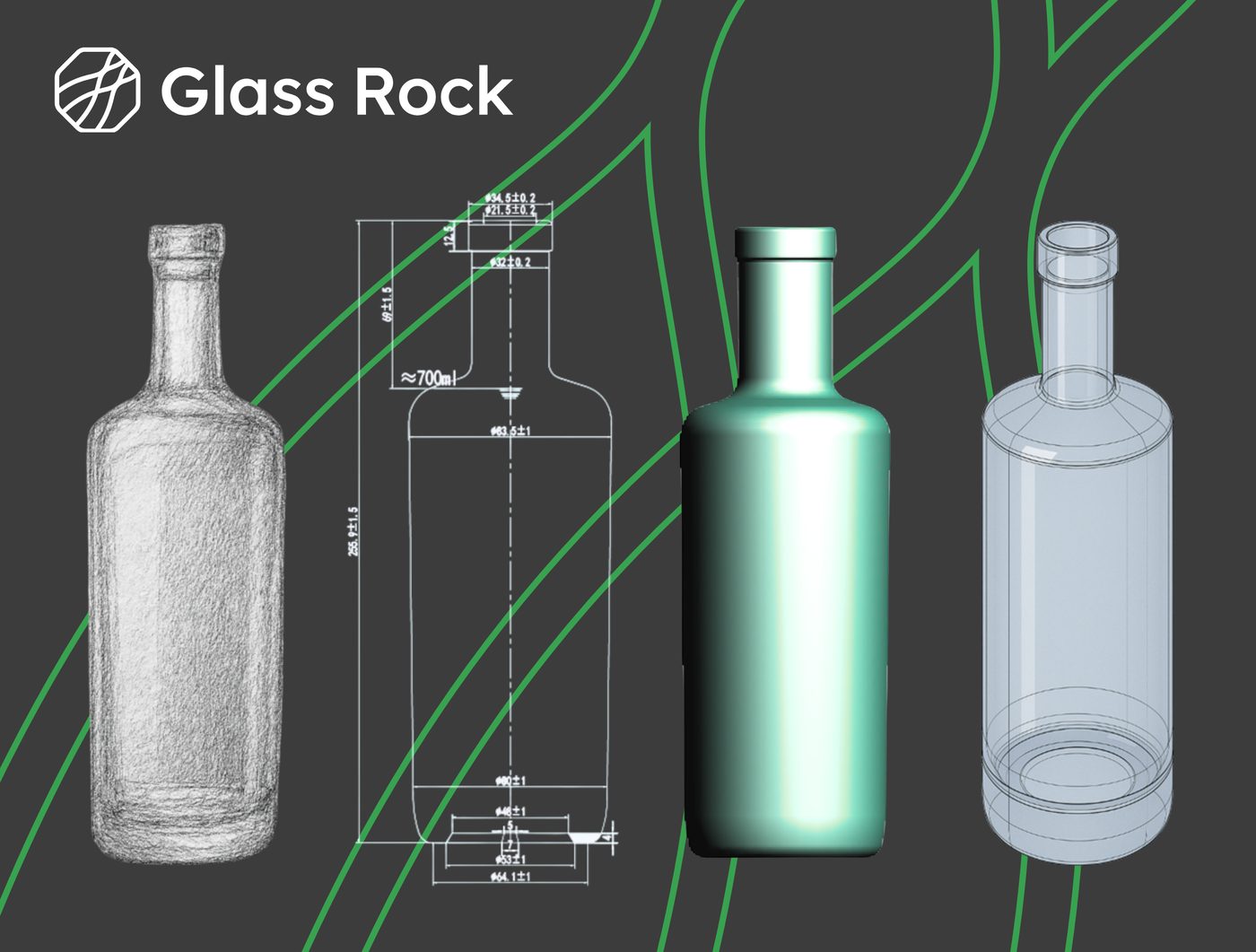
What AI design tools actually deliver
Used well, generative image tools are a real addition to a packaging designer’s toolkit. Three things in particular:
Rapid visual exploration. Forty silhouettes in an afternoon, at a cost that makes it reasonable to explore directions you would never have commissioned. This genuinely widens the search space early in a project, when widening it is cheap.
Stakeholder alignment. A founder, an investor and a designer looking at the same image are having a far more productive conversation than three people describing a bottle in words. For pitch decks and internal sign-off, a render is worth a great deal.
Brief-writing support. This is the most undervalued use. A render you like, annotated with what you like about it, is an excellent input to a manufacturer — far better than an adjective. Manufacturers work from sketches, competitor photographs and renders routinely.
What none of this produces is a specification. The render is the start of the conversation with a glassworks, not the end of it.
The design-for-manufacture gap
The gap is not a matter of resolution or prompt quality. It is categorical: an image model is trained to produce a plausible picture, and pictures are not constrained by the physics of a two-part steel mould filled with molten glass at 1,100 °C.
The recurring issues are consistent enough to list. AI concepts routinely feature undercuts that would trap the bottle in the mould; zero-radius edges that molten glass simply will not flow into; seamless surfaces that ignore the parting line where the two mould halves meet; impossible proportions, typically very tall and very narrow, where glass would thin unpredictably; hairline embossing below the roughly 0.8 mm minimum stroke that will fill and hold; and decorative necks that no standard closure fits.
None of these makes a concept useless. Each of them makes it a concept.
Why glass is more constrained than other packaging
It is worth being specific about why glass is harder than plastic here, because designers coming from other materials are often surprised.
Injection-moulded and blow-moulded plastic is formed at a few hundred degrees, from a material with a well-behaved and narrow melting range, in tooling that can incorporate sliding cores and collapsing sections to release undercuts. Glass is formed at around 1,100 °C from a material with no sharp melting point, which flows under gravity, thins where it stretches, and must be released from a mould that opens along one straight line. There are no sliding cores. The material chooses where it goes as much as the mould does.
That is why glass distribution — how much glass ends up in the shoulder versus the heel — is an engineering discipline rather than a setting. It is also why the same design intent may cost twice as much in glass weight if the proportions fight the process. The physical background is set out in how glass bottles are made.
From AI concept to producible bottle
The conversion is a defined engineering process, and knowing its shape helps you brief it properly.
1. Technical consultation and DFM review. An engineer reads your concept against the forming process and comes back with a list: this radius must increase, this undercut must go, the parting line will run here, this proportion will cost you glass weight. Expect the design to move. The goal is to preserve what makes it recognisable while making it producible — and a good review tells you which features are the identity and which are incidental.
2. Technical drawing. The concept becomes a dimensioned drawing: overall height, maximum body diameter, brimful and nominal capacity, glass weight, neck finish designation, label panel, base profile, and a tolerance on every one. This is the document the mould is cut from and the document your carton and label suppliers work to.
3. 3D model and, usually, a printed prototype. Proportions read differently in the hand than on a screen. A 3D print costs very little and catches misjudgements that survive every render.
4. Mould engineering. Blank and blow cavity design, venting, cooling, parting line placement and draft angles. This is where decades of process knowledge apply and where a shape either becomes economical to run or does not.
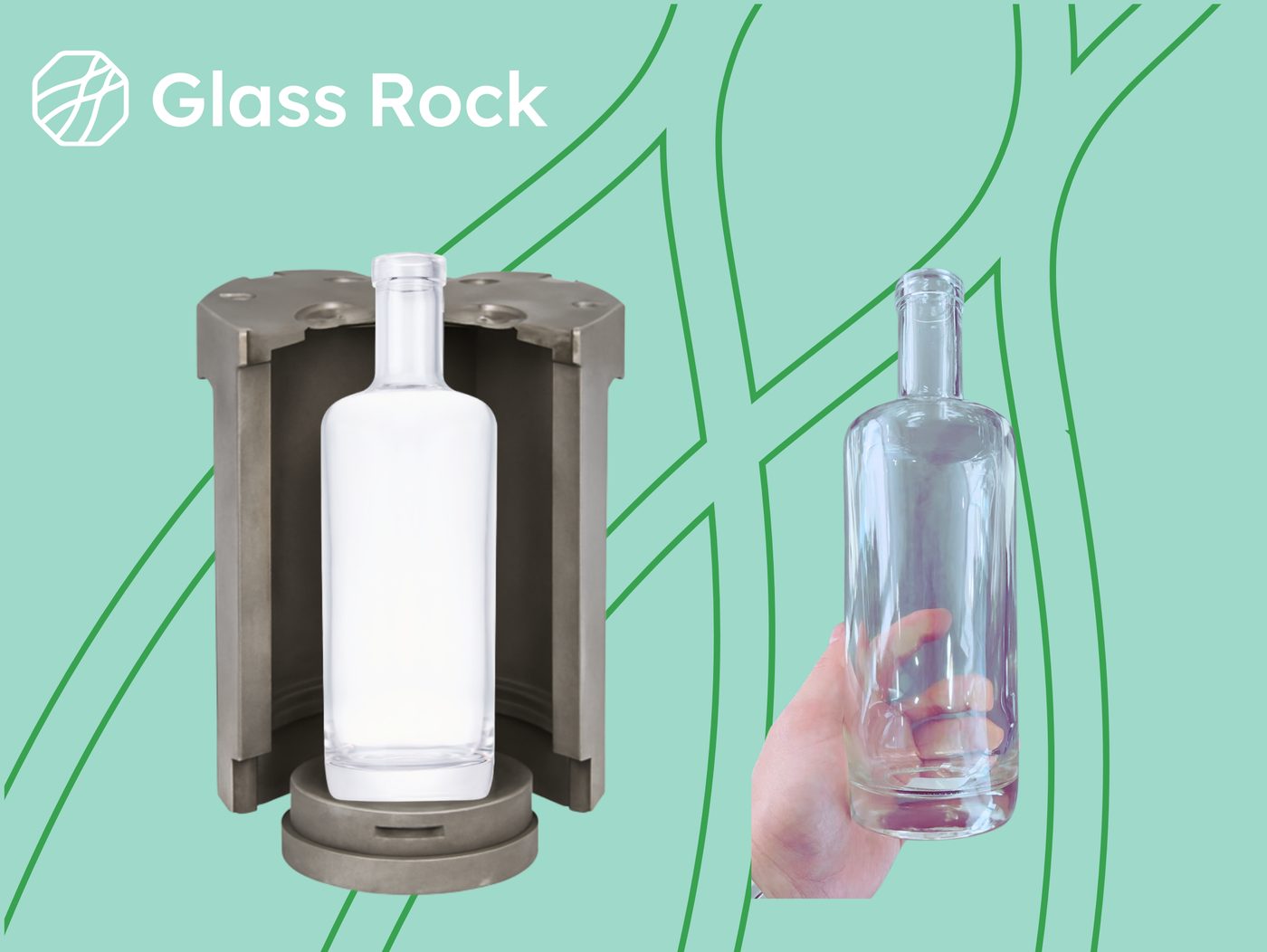
5. Mould trial and first sample. The first glass out of a new mould is where the design is finally judged. Approve on that sample, never on the render.
AI on the factory floor: where it already works
Design is the visible use of AI in this industry and the least mature. Inside the plant, the picture is very different, and considerably more advanced.
Computer vision inspection — deployed and proven
This is the mature application. Every bottle on a modern line passes through multi-camera stations that photograph it from several angles and classify defects at line speed — stones, blisters, checks, bird-swings, finish faults. Machine-learning classifiers have improved this materially over rule-based systems, particularly on the marginal cases that used to be rejected wholesale. The practical benefit to a customer is a lower defect escape rate and less good glass thrown away, both of which show up in price.
Predictive maintenance — widely adopted
Vibration, temperature and current-draw signatures on IS machine mechanisms are used to predict failures before they occur. On a line where an unplanned stop wastes a furnace’s worth of glass, converting unplanned downtime into scheduled maintenance is a substantial economic gain, and it improves delivery reliability.
Furnace and forming process control — real gains, plant-specific
Models that optimise combustion, temperature profiles and gob timing deliver measurable energy and yield improvements. The qualifier is that they are tuned per furnace: every tank has its own geometry, refractory condition and campaign age, so these are not portable off-the-shelf products. Claims in this area should be read with that in mind.
Mould design assistance — emerging
Simulation of glass flow and thermal distribution during forming is genuinely useful for predicting wall thickness distribution before steel is cut. It shortens the trial-and-error loop rather than replacing it. Nobody is cutting production tooling from an unreviewed generative output.
What AI cannot do in glass manufacturing
Three things, stated plainly, because the marketing in this area runs ahead of the reality.
It cannot generate production-ready tooling geometry from a concept image. The constraints are physical, interdependent and specific to a given plant’s equipment.
It cannot substitute for the sample. Simulation narrows the search; first glass from the mould still decides.
It cannot carry regulatory or commercial responsibility — food-contact compliance, fill-level standards, closure compatibility and market-specific format rules all remain human decisions with human accountability behind them.
Timeline, mould cost and MOQ for an AI-originated design
An AI-originated design costs and takes exactly what any other custom design costs and takes. The concept phase is faster and cheaper; nothing downstream changes.
| Stage | Typical duration | What decides it |
|---|---|---|
| Concept generation | Hours to days | Your own iteration, not the supplier |
| DFM review and technical drawing | 1–2 weeks | How far the concept sits from producible |
| 3D model and prototype | 1 week | Optional, strongly advised |
| Mould making | 4–6 weeks | Cavity count and shape complexity |
| Mould trial and sample approval | 2–3 weeks | Whether the first trial is accepted |
| Production slot | Variable | Colour campaign scheduling at the plant |
Mould cost depends on cavity count and complexity, and minimum order quantities for custom bottles typically sit between 30,000 and 100,000 units. The full commercial picture, including how to decide whether to tool at all, is in the guide to custom glass bottle manufacturing.
One point specific to AI-originated work is worth flagging: because concepts are now cheap to produce, it is easy to arrive at a manufacturer with a design that has never been sanity-checked against volume. If your annual volume is 15,000 bottles, the answer may well be a stock bottle with distinctive decoration, however good the render is. That conversation is better had before the DFM review than after.
A practical workflow for brands
- Generate widely, then narrow hard. The value of AI here is breadth of exploration. Produce many, then cut to two or three.
- Annotate what you actually like. “The shoulder angle”, “the proportion of neck to body”, “the flat front panel”. This is what survives the DFM review; the render itself will not.
- Send it early, before you are attached to it. A DFM review costs an email at concept stage. The same conversation after a mould trial costs a mould.
- Settle capacity, closure and market first. These constrain the design more than aesthetics do — see standard formats by market and the closure compatibility guide.
- Check the volume case honestly. Custom tooling rewards proven volume, not optimism.
- Approve on physical glass. Never on the render, and preferably not on the 3D print either.
Frequently asked questions
Can I send an AI-generated bottle design to a manufacturer?
Yes, and it is a perfectly normal input. Manufacturers routinely work from sketches, competitor photographs and renders. Expect the design to change during the design-for-manufacture review, and annotate what you want preserved so the right features survive.
Can AI design a glass bottle that can actually be produced?
Not directly. AI tools generate images, not manufacturing geometry: no wall thickness, no draft angles, no parting line, no glass weight. The concept has to be converted into a dimensioned technical drawing by an engineer before a mould can be cut.
Why do AI bottle designs get rejected by manufacturers?
Usually for one of six reasons: an undercut that would trap the bottle in the mould, zero-radius edges that glass will not flow into, a shape that ignores the parting line, extreme proportions that thin the glass unpredictably, embossing below the minimum stroke width, or a neck no standard closure fits. All six are fixable at concept stage.
Does an AI-originated design cost more to produce?
No. Once it becomes a technical drawing it is simply a custom bottle, priced on capacity, weight, colour, complexity and volume. What varies is the engineering effort to get there, which depends on how far the concept sits from something glass can form.
Is AI used in glass bottle manufacturing itself?
Yes, extensively, and far more maturely than in design. Computer vision inspection is deployed at scale on modern lines; predictive maintenance is widely adopted; furnace and forming process control models deliver real energy and yield gains. Generative design is the least mature of the four.
Will AI replace bottle designers?
It has changed what the early phase of the job looks like — exploration is faster and cheaper than it was. The parts that decide whether a bottle exists, namely design-for-manufacture judgement, tolerance and tooling engineering, and commercial accountability, are not tasks image models perform.
What should I send along with an AI render?
Target capacity, market, annual volume, closure family, glass colour, target weight or positioning, decoration intent, and a note on which features of the render matter to you. That set lets a manufacturer respond with a drawing and a real quotation rather than a range.
Can I 3D print a glass bottle prototype?
You can 3D print a resin or plastic model to judge proportions in the hand, and it is well worth doing before mould making. It will not behave like glass in weight or optics, and it is not a production sample — the first bottle from the mould trial remains the thing you approve.
 English
 French
 Spanish
 Portuguese
 German
 Italian
 Japanese
 Korean
 Arabic
 Russian